Share:

Country Selector
Africa
Asia Pacific
Australasia
Europe
Latin America and Caribbean
North America

In the past, growers often applied more nitrogen than the crop used. They anticipated and accounted for losses of nitrogen due to leaching or denitrification. But advice now is to only apply the amount of nitrogen required by the crop to fulfil its yield potential. This advice is underpinned by fertiliser economics and environmental considerations.
Essential tools for optimising nitrogen efficiency
There are several tools growers may adopt to improve nitrogen use efficiency. Simply applying nitrogen doesn’t guarantee it will still be there when the crop requires it.
Nitrogen stabilisers such as Instinct® will keep nitrogen in the root zone, optimising yield potential and reducing both greenhouse gas emissions and nitrogen leaching. This is essential to enabling sustainable and productive agriculture.
In fact, Instinct Nitrogen Stabiliser retains 28% more nitrogen during the period of peak nitrogen demand by the crop.
What causes nitrogen loss?
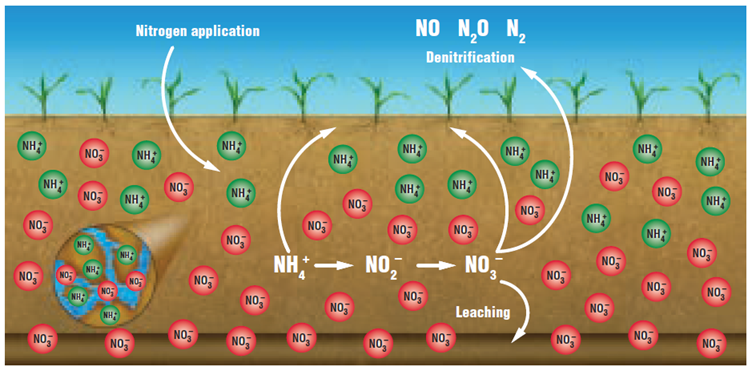
Nitrogen losses may occur by leaching, ammonia volatilisation and denitrification.

Leaching
Leaching is the loss of nitrates to the soil below the root zone. It can be caused by rain and irrigation. Leaching occurs because soil and organic matter are negatively charged, as are NO2- and NO3- nitrates. This means they are easily washed away, with leaching most common in coarse, sandy soils.
Instinct Nitrogen Stabiliser reduces leaching by 48%.

Volatilisation
Volatilisation is a process that converts usable nitrogen into ammonia gas, which escapes into the environment instead of getting into the root zone. Heat from the sun accelerates this process, causing nitrogen in the soil that hasn’t yet been absorbed to evaporate. As a result, crops miss out on the benefits of this essential nutrient.

Denitrification
Denitrification is the loss of nitrogen into the atmosphere. This occurs when soil microbes convert nitrates to gaseous forms of nitrogen, and these escape into the atmosphere as greenhouse gas. Denitrification doesn’t affect ammonium, just nitrates.
Instinct Nitrogen Stabiliser reduces denitrification by 44%.
How can I prevent nitrogen loss?
Using nitrogen stabilisers is the best way to reduce nitrogen loss in soil. There are three different types of nitrogen stabilisers:
- Slow or controlled-release stabilisers - those are coated in a synthetic polymer that cause water to diffuse slowly through the coating.
- Urease inhibitors - urease inhibitors affect the urease enzyme, catalysing the hydrolysis of urea on the soil surface. A small amount of soil moisture can cause the unprotected urea to hydrolyse. It then converts to ammonium and carbon dioxide, which could then be lost through volatilisation.
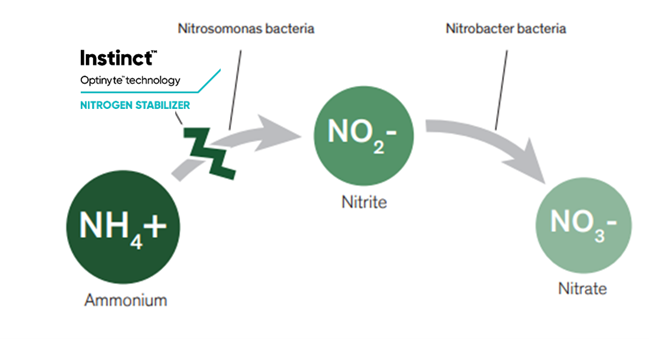
- Nitrification inhibitors - these slow down the conversion of ammonium at the first stage of nitrification. The Nitrosomonas bacteria that initiates the conversion from NH4+ to NO3- is inhibited, which means usable nitrogen is stored at the root zone.
Using stabilisers such as Instinct Nitrogen Stabiliser will help reduce leaching by 48%, reduce nitrous oxide emissions by approximately 50% and keep 28% more nitrogen in the soil for longer.
Instinct®
Simply stated – Instinct keeps more nitrogen in the soil for longer.
Instinct® is a nitrification inhibitor. It works by slowing down the conversion of ammonum into nitrate. Nitrate can be lost from soils and into the environment by leaching or greenhouse gases.
The benefits of Instinct nitrogen stabiliser
- Improving efficiency and productivity
- Prevent nitrogen leaching
- Reduce greenhouse gas emissions
Recent Nitrogen Management articles
This maize planting season, using a nitrogen stabiliser could stabilise enough N to allow growers to reduce applications by up to 20%, whilst still maintaining yields. Read more from Corteva's Colin Bowers here.