Historically, growers often applied more nitrogen than the crop was expected to use, allowing for potential losses through leaching or denitrification. Current guidance, however, recommends applying only the amount of nitrogen needed to meet the crop’s yield potential. This approach is driven by both fertiliser economics and environmental responsibility.
What causes nitrogen loss?
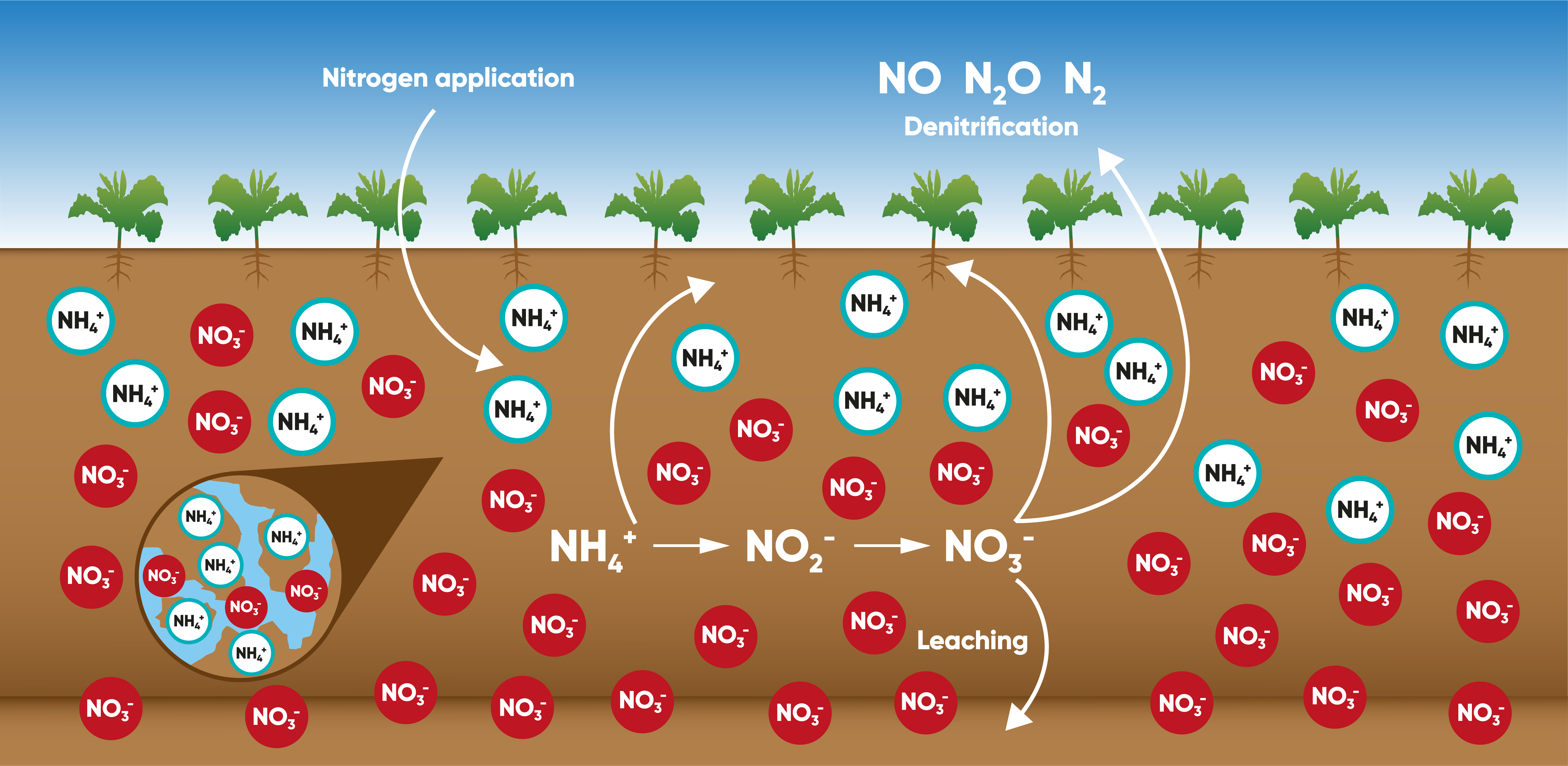
Nitrogen losses may occur by leaching, ammonia volatilisation and denitrification.

Leaching
Leaching is the loss of nitrates as they move down through the soil beyond the crop’s root zone, often as a result of rainfall or irrigation. This happens because soil and organic matter are negatively charged, as are nitrate forms such as NO₂⁻ and NO₃⁻, meaning they are not held tightly in the soil and can be easily washed away. Leaching is most common in coarse, sandy soils where water moves more freely.
Instinct Nitrogen Stabiliser helps reduce leaching by up to 48%, keeping more nitrogen available where the crop can use it.

Volatilisation
Volatilisation is the process by which usable nitrogen is converted into ammonia gas and lost to the atmosphere, rather than reaching the crop’s root zone. Warm conditions and sunlight can accelerate this process, increasing the risk of nitrogen loss before it is absorbed by the plant. As a result, crops may miss out on the full benefit of this essential nutrient.

Denitrification
Denitrification is the loss of nitrogen to the atmosphere. It occurs when soil microbes convert nitrates into gaseous forms of nitrogen, which can then escape from the soil as greenhouse gases. Denitrification affects nitrate nitrogen, but not ammonium nitrogen.
Instinct® Nitrogen Stabiliser helps reduce denitrification by up to 44%, keeping more nitrogen available to the crop.
How can I prevent nitrogen loss?
Using nitrogen stabilisers is the best way to reduce nitrogen loss in soil. There are three different types of nitrogen stabilisers:
- Slow or controlled-release stabilisers - these are coated in a synthetic polymer, which allows water to diffuse gradually through the coating. This slows the release of nitrogen into the soil, helping to make it available to the crop over a longer period.
- Urease inhibitors - urease inhibitors affect the urease enzyme, catalysing the hydrolysis of urea on the soil surface. Even a small amount of soil moisture can cause unprotected urea to hydrolyse, converting it into ammonium and carbon dioxide. This can increase the risk of nitrogen loss through volatilisation.
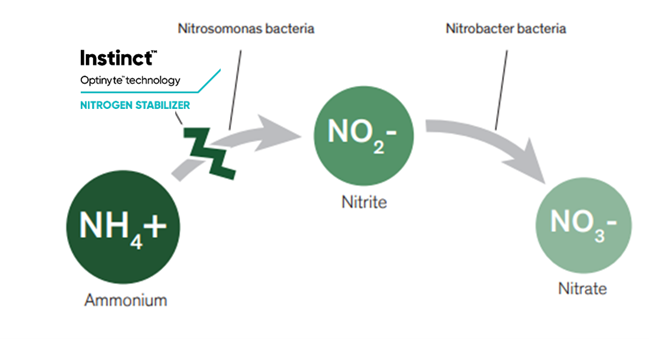
- Nitrification inhibitors - those slow down the conversion of ammonium during the first stage of nitrification. They inhibit the activity of Nitrosomonas bacteria, which initiate the conversion of NH₄⁺ to NO₃⁻. This helps keep usable nitrogen in the ammonium form for longer, retaining it within the crop’s root zone.
Products to optimise nitrogen efficiency
Nitrogen stabilisers, such as Instinct®, can be used to improve nitrogen use efficiency. Instinct will keep nitrogen in the root zone, optimising yield potential and reducing both greenhouse gas emissions and nitrogen leaching. This is essential to enabling sustainable and productive agriculture.
In fact, Instinct Nitrogen Stabiliser retains 28% more nitrogen during the period of peak nitrogen demand by the crop.
Using stabilisers such as Instinct, will help reduce leaching by 48%, reduce nitrous oxide emission by approximately 50% and keep 28% more nitrogen in the soil for longer.