Share:

Corporate Global
Corporate Global
Africa
Asia Pacific
Australasia
Europe
Latin America and Caribbean
North America
Corporate Global
Article
Supporting More Resilient Cereal Farming Across Europe

Cereal grain farmers in Europe are part of a long tradition that stretches all the way back into prehistory. Today, cereal grains, such as wheat, oats and barley, are grown on nearly half of the region’s farms, delivering 20% of the world’s cereal supply.1
Like farmers in many parts of the world, cereal growers in Europe face increasing challenges to keep their operations profitable and sustainable. Overcoming these issues requires innovative solutions to complex problems and working closely with crop protection experts who can help them make the most of technologies in their fields.
Addressing agronomic threats in cereals
Agronomic issues are evolving for these farmers. Shifts in weather patterns mean new and different pressures. Diseases, pests and weeds are appearing in new places and at different times, while resistance makes them harder to control. Water usage and soil health are also primary concerns in this region.
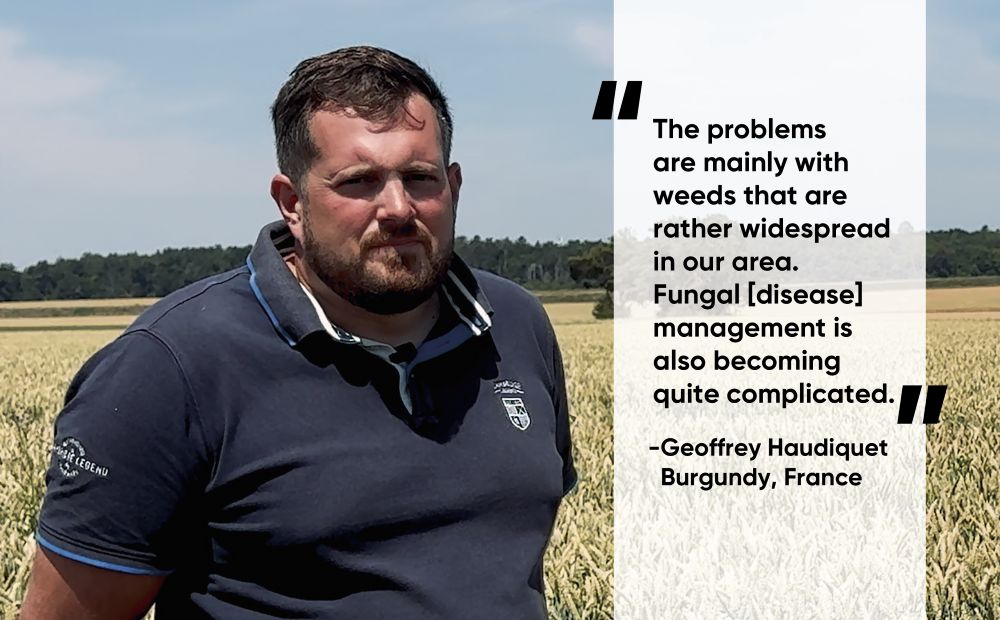
Geoffrey Haudiquet, who farms in Burgundy, France, is dealing with multiple issues across the season. “The problems are mainly with weeds that are rather widespread in our area. We will have grass which comes back often and then some perennials and [broadleaf weeds],” he said. “After that, we’ll have all the diseases that we find in the spring. Fungal [disease] management is also becoming quite complicated.”
In Kalkar, Germany, Max Willemsen farms cereals as well as hybrid rapeseed, which is sold for planting. “The most important thing is a clean field, because the farmers who reseed our seeds afterwards don’t want to sow any weeds,” he explained.
For Marcin Jezierski, an agronomist in Chobienice, Poland, the biggest challenge is water stress. “We have to approach it strategically year by year when it comes to planning, sowing structure, fertilization or fungicide and herbicide protection.”
“One of the biggest challenges for us is the soil type that we are on, which is very heavy clay,” said Bryony Graham, who manages an arable farm alongside her brother in Essex, UK. “Current weather patterns and the pace at which the weather is changing in the UK are making the way we have traditionally managed this land very, very challenging.” She noted that black grass is a particular issue for her family’s farm and that it requires a careful rotation and herbicide strategy.
Managing with fewer cereal crop protection options
With increasing threats to control, farmers in this part of the world also find themselves with fewer crop protection active ingredients to choose from, in some cases due to changes in regulatory policies.
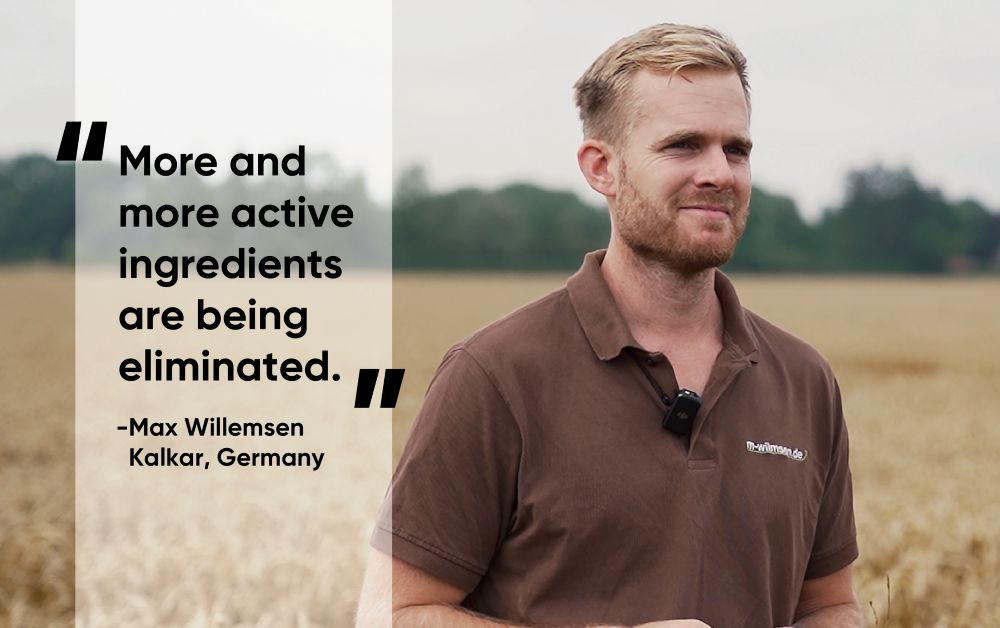
Despite a robust crop rotation strategy, Willemsen said disease pressure can still be an issue. He worries about having adequate modes of action to protect his crops. “We are already noticing that, especially in the potato sector but also in the grain sector, more and more active ingredients are being eliminated.”
Henrik Braun is Willemsen’s Corteva Agriscience representative. He wants his customers to have as many options as possible. “There are products from company A or B in every segment that fit in very well. But above all, we need new active ingredients.”
Graham recognizes the important role of stewardship in maintaining efficacy. “We need to think broadly about the kind of products we use and stewardship approaches that we have for existing chemistries, to make sure that we maintain access to these products and that we use them in the most environmentally sensitive way,” she said.
Changing practices for more profitable and productive cereal harvests
Like any commodity crop, cereals are subject to market volatility, which makes it difficult to reliably predict profitability. Regulatory shifts add to this uncertainty. Farmers have to continually adjust based on what crop protection products are approved and available where they farm, and which will be accepted for trade.
Adding to the business complexity, many cereals farms across the region are passing to the next generation, while some are merging with other operations or diversifying their businesses to be more profitable. This introduces new opportunities but also requires willingness to adjust business practices to serve their operations well into the future.
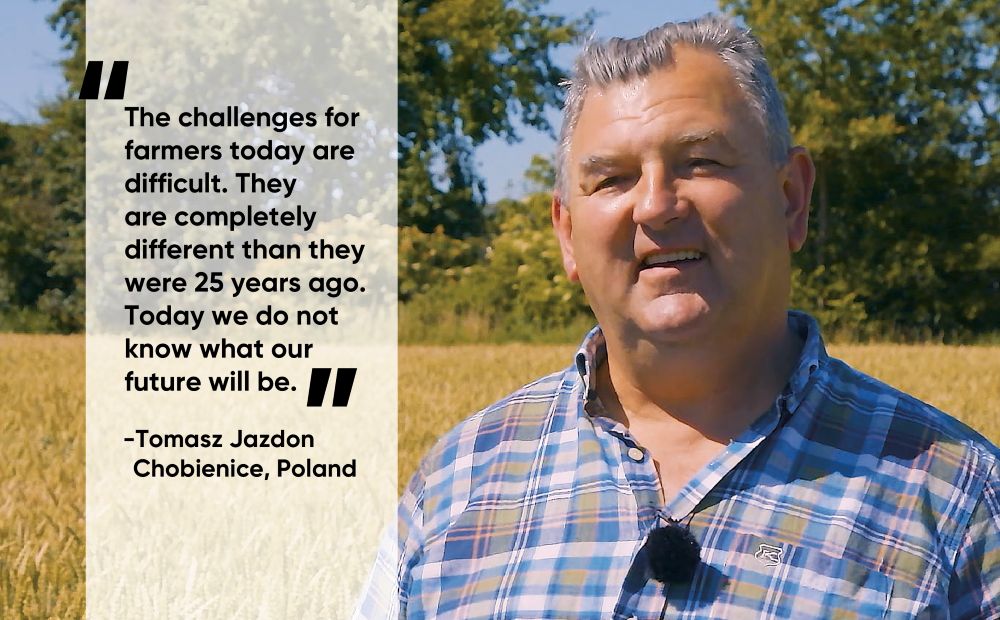
Tomasz Jazdon, a farmer in Chobienice, Poland, said, “The challenges for farmers today are difficult. They are completely different than they were 25 years ago. Today, we do not know what our future will be. We are currently struggling for the profitability of our production. The economy has changed tremendously. The future is precisely about production and cost optimization. Farms need to be bigger, more effective and more efficient.”
Willemsen echoed this sentiment, saying, “The challenges are: How do I set up my business so that it can continue to be operated economically in the future? What will really happen in ten years?”
For Graham, the generational transition of the family farm has highlighted a need to do things differently. “We were in a difficult place in terms of the business overall, and we knew we needed to look at the bigger picture,” she said.
Adopting solutions for a successful cereal farming future
With their sights trained on long-term business and environmental sustainability, cereal farmers in Europe are revising their management practices and embracing new technologies.
Marian Kraśner is a Corteva Agriscience Representative who works with farmer Tomasz Jazdon and agronomist Marcin Jezierski in Poland. He sees the potential when farmers are open to new solutions. “From the very beginning, when new molecules began to appear on the market, whether from our portfolio or from other companies, Mr. Tomasz has been an innovation leader and always introduces these solutions to his fields,” he said. “He is always looking for interesting, new alternatives to show people that success lies in new technologies.”
Management practices have changed on the Jazdon farm as well, including planting fewer seeds. Kraśner noted, “The competition of plants for water is not so high. In the case of cereals, the ears are much more ripe and have more kernels.”
On Graham’s farm in the UK, they’re trying new crop rotation strategies as well as implementing naturally derived crop protection solutions. “We need to look more broadly at different products that are available, like the biologicals and seed dressings that give us a non-synthetic chemistry approach to maximizing yield from our crops,” she said. “I hope that in five years’ time, we’ve reset that balance and got back to a point where we’re maximizing the potential of even the most challenging fields on the most difficult soil.”
In Germany, Willemsen is leveraging new modes of action and, like Graham, is drawn to crop protection solutions rooted in nature. “I think of Corteva as a company that really deals with the biological basis of crop protection. And that, I think, is already promising for the future,” he said.
At the time we spoke, he’d recently completed treatment with Univoq™ fungicide, describing it as “a totally strong septoria remedy” he said.
In France, Haudiquet is finding multiple crop protection solutions from Corteva that are a good fit for his farm. “The advantage of the Corteva portfolio is that the range of products is rather wide,” he said. “We’re going to have a solution, I wouldn’t say entirely, but for a large part of our problems, whether it’s weeds or fungal.”
Forging productive futures
Despite the many challenges facing their farms and the industry as a whole, cereal farmers in Europe remain resilient and passionate about their work.
“Being a farmer is a beautiful profession if you love it,” Jazdon said. “Because if we do anything in life that we love, we do not count either the time of work or the effort that is associated with it.”
“Every day is different and is a new challenge. And, yes, of course there are long days,” Willemsen said. “That means you have a lot to manage, but that’s also fun somehow. When you see a field which has developed badly in winter and can somehow nurse it up so that it now stands here so beautifully? These are the things that are fun about the job.”
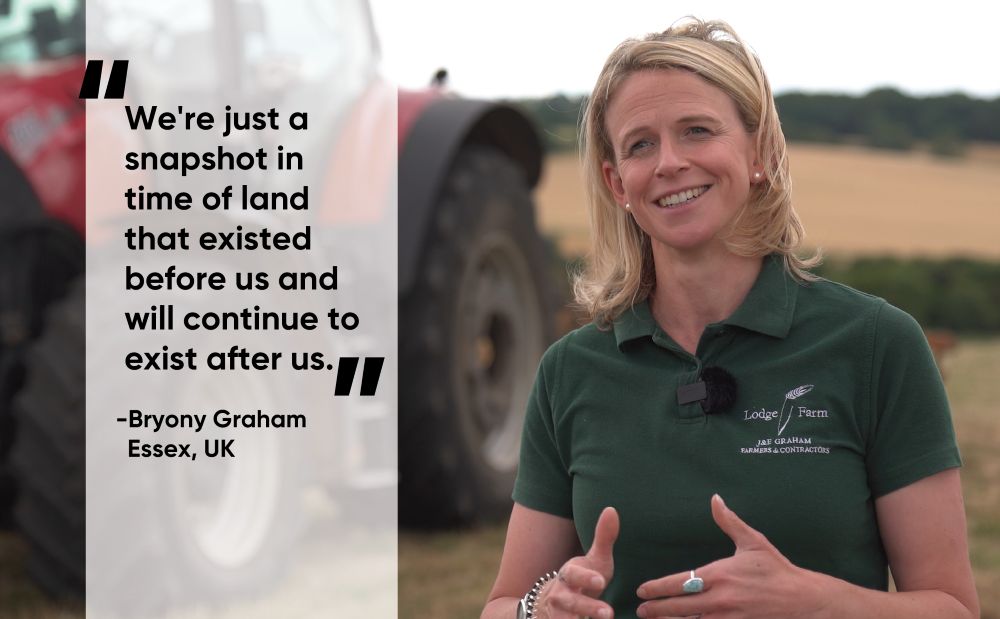
“To me, what makes being a farmer special is the feeling of being part of something bigger than yourself,” Graham said. “I think, ultimately, we are, as people, such a small part of the land. We’re just a snapshot in time of land that existed before us and will continue to exist after us. How we manage that land in the time we are responsible for it feels quite powerful.”
1 “Participating European countries,” Global Yield Gap Atlas, Accessed September 17, 2025, www.Yieldgap.org/Europe.
Univoq™ fungicide is not registered for sale or use in all countries. Contact your local regulatory agency to determine if a product is registered for sale or use in your area. Always read and follow label directions.