
Country Selector
Africa
Asia Pacific
Australasia
Europe
Latin America and Caribbean
North America

Scroll down to find out information on how to optimise applications of Forefront T. Alternatively, download the information in PDF format here.
Manure management
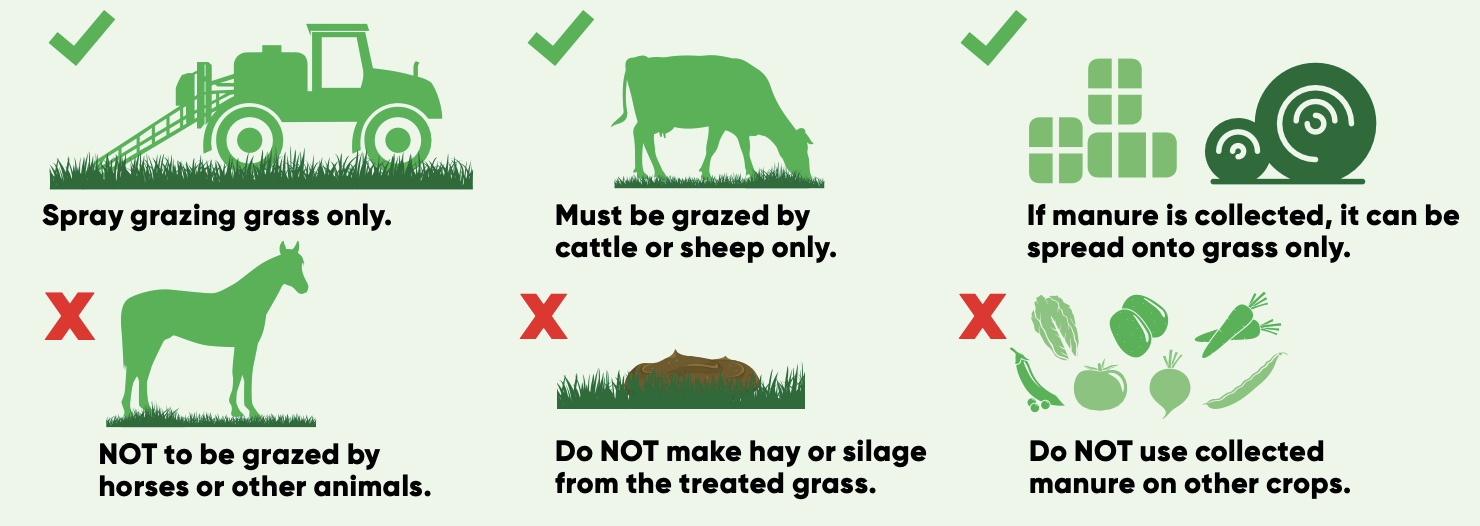
- DO NOT use Forefront® T on grass that will be cut for animal feed (i.e. fresh cut grass, silage, hay or haylage) as herbicide residues will carry over into the forage and unwanted growth effects can result if this manure is applied to sensitive crops like potatoes or tomatoes in a green house. The graphic shows the do’s and don’ts.
- Treated grass must not be cut for animal feed (i.e. fresh cut grass, silage, hay or haylage) in thesame calendar year of treatment.
- Animal feed (i.e. fresh cut grass, silage, hay or haylage) produced from the treated area after an interval of 12 months, must stay on farm and manure from animals fed on this must stay on farm and be spread only onto agricultural grassland.
- DO NOT apply to flower-rich grassland. Cattle and sheep which have grazed Forefront T treated grassland must graze non-Forefront T treated grassland for 3 days prior to grazing flower rich grassland.
Guidance on ragwort control
- Forefront T is particularly effective on common ragwort (>90% control). Common ragwort (Senecio jacobaea) tends to be found in poorer quality pastures. It is normally a biennial plant. A rosette in its first year that in its second year sends up one or more leafy unbranched stems that usually extend to 30-90 cm high.
Application timing is crucial to achieve good levels of control. It is recommended to spray common ragwort at the rosette stage, up to but before stem extension, when it is growing actively.
- Livestock must be kept out of the treated area until treated ragwort has died and completely rotted down.

Reseeding intervals
- Weed removal can lead to bare patches which may require reseeding.
- Where reseeding is necessary then our guidance on intervals for a range of plant species typically found in multi-species swards is shown here:
| Species | Reseeding interval |
| Grass | 1 month |
| White clover | 4 months |
| Red clover | 4 months |
| Plantain | 4 months |
| Chicory | 4 months |