
Country Selector
Please enter a valid location
Is Gray Leaf Spot Coming for Your Corn?
Gray leaf spot is an annual threat in cornfields from the Midwest to the Atlantic Coast that has been developing into new areas in recent years. All corn hybrids in this region, regardless of type, have some susceptibility.
In addition to geography, there are many factors that contribute to the risk of gray leaf spot damage in corn. Climate, moisture, cropping system, weed pressure, timing and tillage practices are other considerations to take into account when assessing fields for disease risk.
Timing
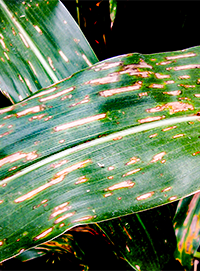 Late-planted corn is exposed to disease at vulnerable early growth stages and can suffer higher levels of infection. Significant yield loss can occur if leaf area is destroyed before grain fill is complete. Early infection also allows more time for secondary outbreaks, disease spread and leaf damage — resulting in even greater yield losses.
Management tips
In its early stages, gray leaf spot symptoms may be confused with other foliar fungal diseases, including anthracnose leaf blight, eyespot and common rust. To verify, hold a leaf up to the light and look for a yellow halo around pinpoint lesions.
Hybrids with partial gray leaf spot resistance may restrict lesion growth, displaying small lesions with round or jagged shapes instead of the long, rectangular lesions on more susceptible hybrids.
Corteva Agriscience offers effective, fast-acting fungicides that can help protect against and mitigate gray leaf spot. Aproach® Prima fungicide offers dependable disease control by quickly penetrating plant tissue to protect crop health and maximize productivity. Forcivo™ fungicide helps protect your crop with up to 30 days of residual control, giving you a powerful disease management tool that bolsters plant health and yield potential.
Keep records of potential outbreaks throughout the season. Record scouting notes and field observations to serve as a historical record of location, severity and time of outbreaks for next year's planning.
Impact on yield
The disease appears in cornfields most growing seasons without significant effect on yield. If conditions favoring the disease are especially persistent, then yield losses in excess of 50% can occur if left untreated.
Symptoms
Long, thin, rectangular lesions, up to 2 inches in length, appear on leaves. The lesions start out tan and usually turn gray.
Conditions for development
Warm temperatures and high humidity create an optimal environment for gray leaf spot. Periods of fog can trap moisture in the canopy, sparking an outbreak. Heavy wind and rain aid spread of disease from soil to and among developing plants.
Infection requires leaf surfaces to be wet for 11 to 13 hours and relative humidity in the leaf canopy to be at least 90 percent for 12 to 13 consecutive hours.
Gray leaf spot fungus overwinters in corn residues, making the threat of infection greater with continuous corn.
Weeds block air movement through the canopy, holding humidity and preventing leaf surfaces from drying, which increases disease risk.
Aproach® Prima and Forcivo™ are not registered for sale or use in all states. Contact your state pesticide regulatory agency to determine if a product is registered for sale or use in your state. Always read and follow label directions.