
Country Selector
Please enter a valid location

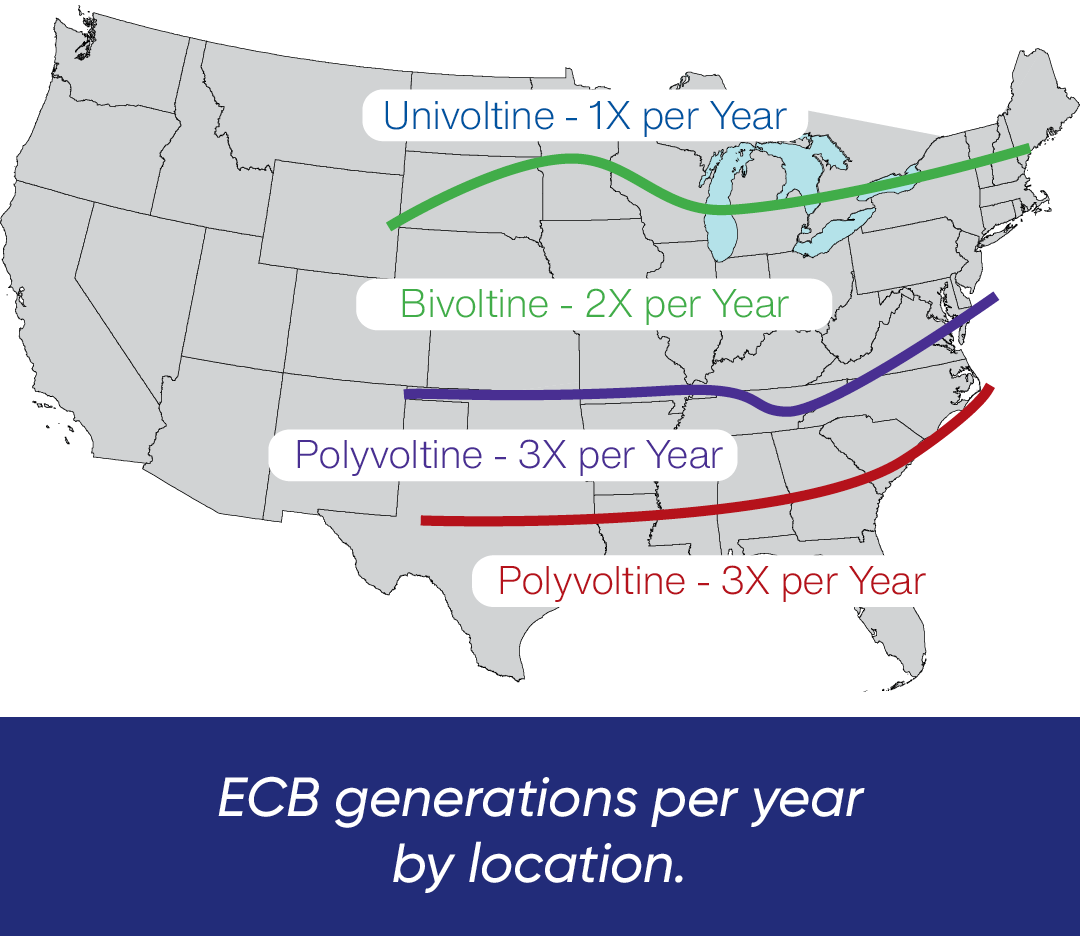
European corn borer (ECB), native to Europe and western Asia, was first documented in the U.S. in 1917 around Boston, Massachusetts. By the early 1950s, it had become a significant economic concern, occupying most major corn-growing areas in the U.S., with damage and management costs growing to more than a billion dollars annually.1 The advent of Bt corn in the 1990s greatly reduced ECB presence to manageable levels. However, populations are still present in the U.S., and currently most corn-growing areas east of the Rocky Mountains play host to ECB. It can produce multiple generations per year, with only the cold of the northernmost states restricting its yearly cycles. While not the threat it once was, infestations can still occur, and Bt-resistant populations were found in Canada in 2019, highlighting the need for continued vigilance.
Identification
Eggs
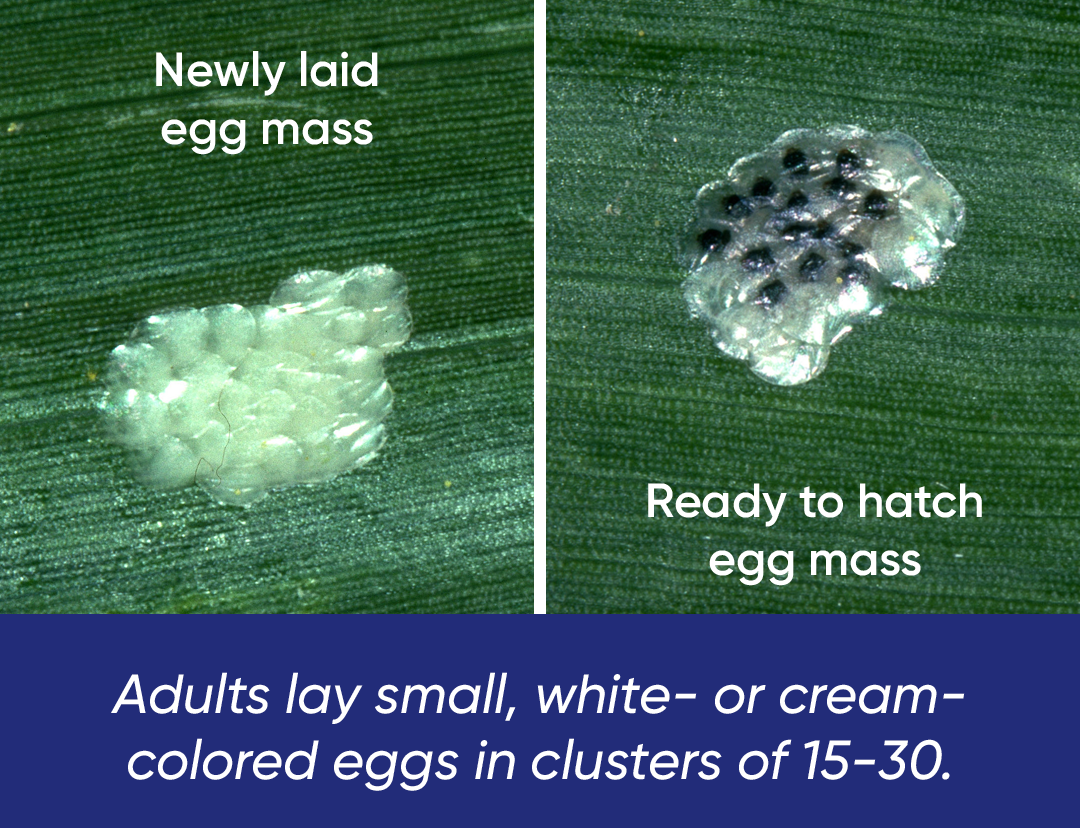
Female moths lay 15-30 eggs in creamy- or white-colored clusters. First-generation moths tend to choose early planted corn to host the young, while second-generation females prefer late-planted, actively pollinating corn.
Larvae
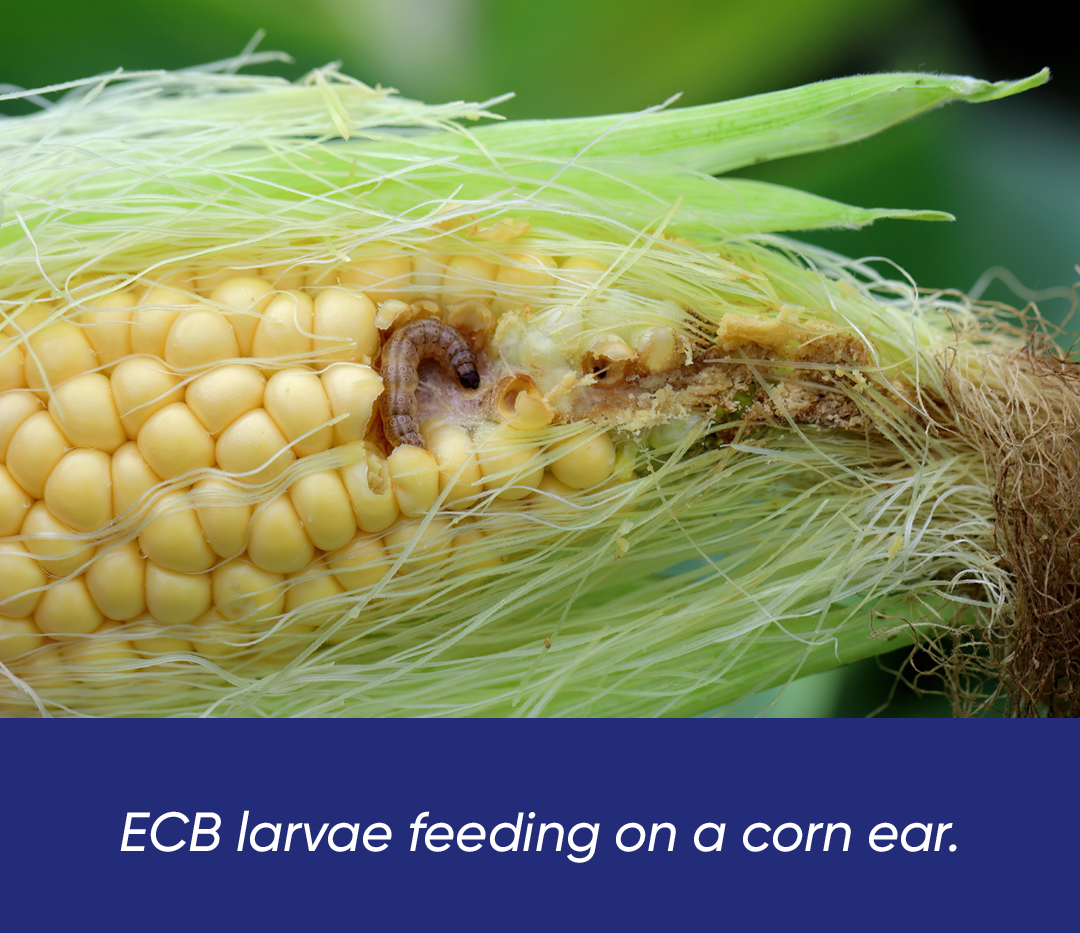
ECB larvae are white with a black head when first born. Their body coloring gradually changes as they age and can vary from creamy colored to gray to pink. Rows of small, brown spots run the length of their bodies. At full maturity, they measure about one inch long.
Adults
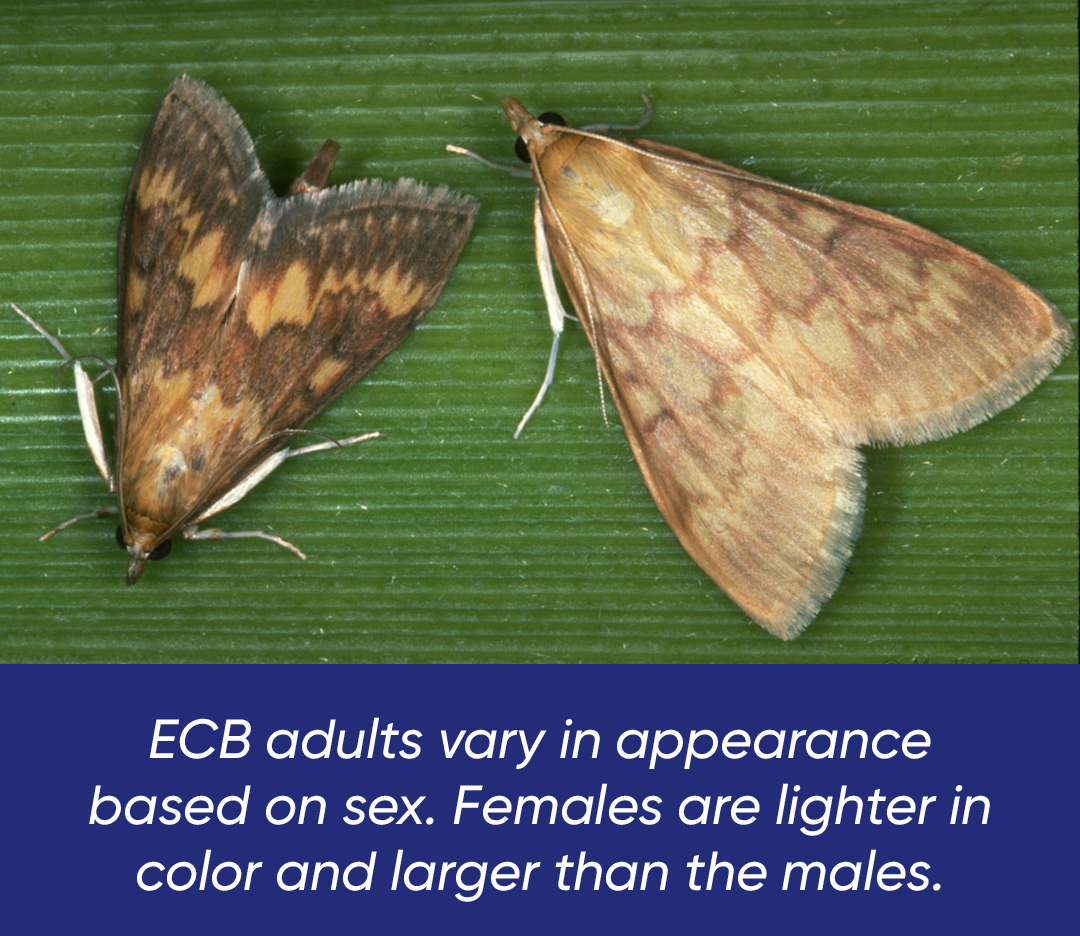
Adult ECB moths vary in size and coloring according to their sex. Females measure roughly 5/8-inch long; males are slightly smaller. Their wings span about one inch and on females are light yellowish-brown with wavy, dark brown bands running across them near the rear. Males share similar patterning but with notably darker colors.
Life cycle
The life cycle of ECB differs depending on whether it is first or second generation. First instar larvae “windowpane” young leaf tissue, feeding on it without eating completely through the leaf. As they mature, the larvae will fully chew through the leaf, creating a distinctive “shot hole” pattern. Upon reaching the third instar, larvae start to feed on the whorl, eventually tunneling into the stalk. Once inside, they pupate during July and early August, emerging as an adult after 7-10 days.
Second generation larvae emerge from late July through August, feeding on either pollen that has built up in the leaf axil or on the axil itself near the stalk. Since mature corn stalks are hard, young caterpillars will not feed on them initially. However, they do feed on tassels and can cause ear drop by feeding on shanks. Once they reach their fourth instar, larvae enter the stalk, where they mature to their fifth instar and remain in diapause through the winter.
Plant injury
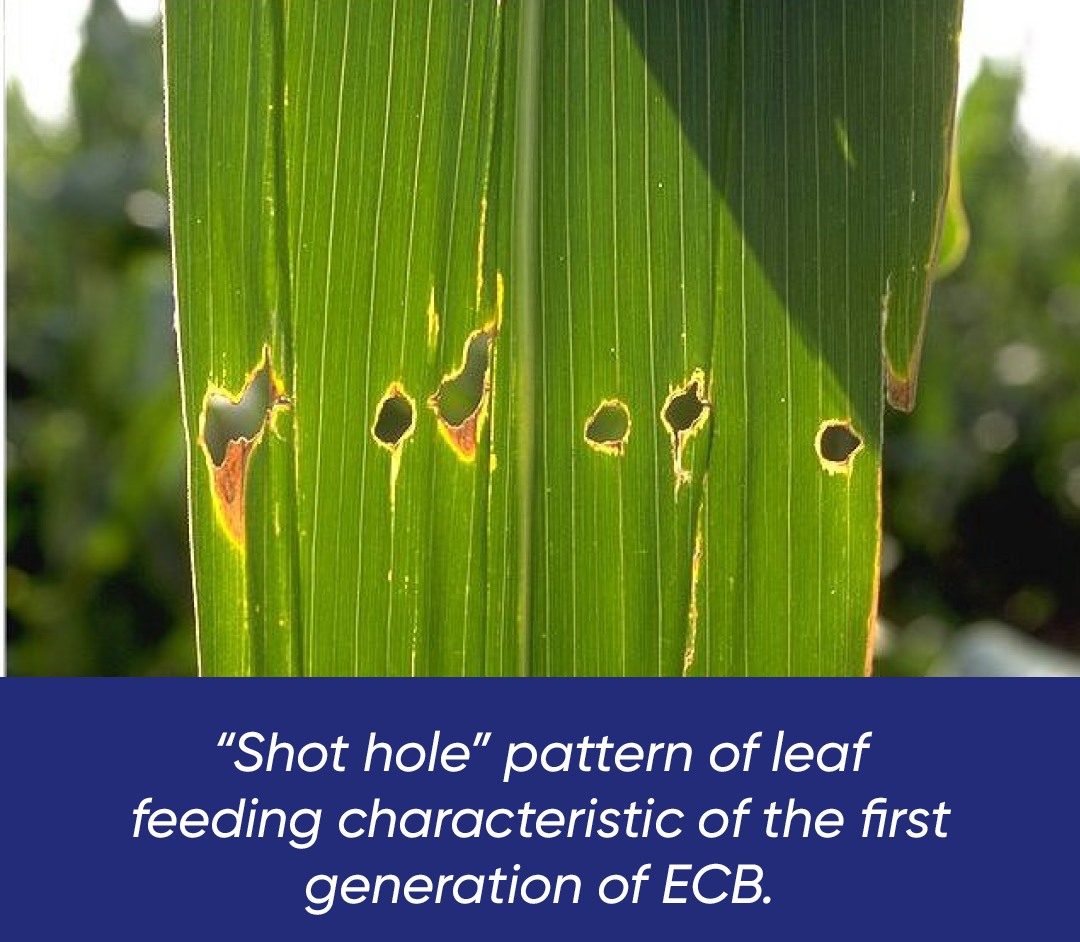
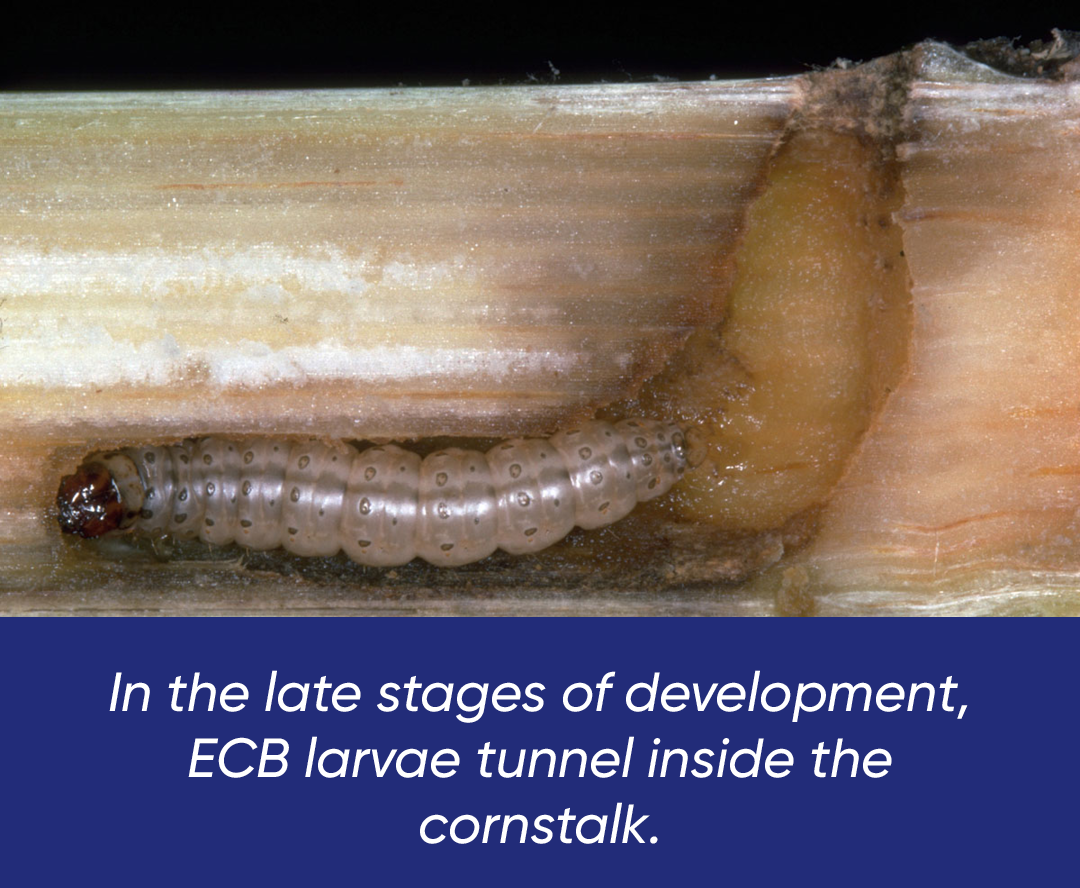
All parts of the corn plant are susceptible to injury from ECB except the roots. The major damage — tunneling into stalks, ear shanks and ears — interferes with the plant’s water and nutrient uptake. This can cause stalk lodging and ear drop as well as make the plant more susceptible to stalk rots and ear molds. Factors such as the plant’s maturity when attacked, its growing environment and hybrid tolerance or resistance can affect the severity of yield reduction. Pre-tassel corn can suffer losses of 6% per borer per plant, while post-pollination plants may experience up to 3% loss per borer per plant.2
Scouting
The optimum treatment window for ECB is only about 4–6 days under normal temperatures. Scouting timing is crucial because once larvae burrow into stalks, insecticides are of little use. Scouting for shot hole feeding in leaves should not begin until 200 growing days after corn has reached 18 inches in height. Black light and pheromone trapping during mating can help inform field scouting. For second-generation ECB, egg cluster scouting is recommended, beginning when moths are found in light and pheromone traps. Farmers should be aware that field edges and grassy waterways may attract more moths and egg deposition, throwing off sampling estimates in these areas.
Management
Insecticides have proven effective on first-generation ECB when timed properly, but second-generation treatments are often less complete, achieving only about 65% control.3 Cultural methods like tillage may also be employed to help reduce the amount of overwintering larvae in stalks, though adults may still migrate and reinfest an area. In contrast, the use of Bt-traited corn has proven to be a consistently effective method for managing ECB. PowerCore® Enlist® corn includes three MOAs against ECB, bringing long-lasting control to susceptible populations and helping eliminate the need for scouting and insecticide application.
While ECB used to be a significant threat in corn, vigilance in scouting and the use of Bt-traited corn has effectively turned this pest into little more than a nuisance. Only time will tell how ECB continues to evolve. But as more and more farmers switch from double- to triple-traited hybids for above-ground protection, there’s good reason for optimism.
1 Calvin Widfrid et al., “European corn borer: Old pest, new problems,” Minnesota Crop News, February 20, 2024, https://blog-crop-news.extension.umn.edu/2024/02/european-corn-borer-new-pest-old.html.
2 Bruce Potter, “European corn borer in Minnesota field corn,” University of Minnesota Extension, Reviewed 2020, https://extension.umn.edu/corn-pest-management/european-corn-borer-minnesota-field-corn.
3 “European Corn Borers (Corn),” Purdue University Extension, June 6, 2026, https://ag.purdue.edu/department/entm/extension/field-crops-ipm/corn/european-corn-borers.html.

™ ® Trademarks of Corteva Agriscience and its affiliated companies. POWERCORE® is a registered trademark of Bayer Group. POWERCORE® multi-event technology developed by Corteva Agriscience and Bayer Group. Always follow IRM, grain marketing and all other stewardship practices and pesticide label directions. Bt products may not yet be registered in all states. Check with your seed representative for the registration status in your state. Enlist Duo® and Enlist One® herbicides with Colex-D® technology are the only herbicides containing 2,4-D that are authorized for preemergence and postemergence use with Enlist® crops. Enlist Duo and Enlist One herbicides are not registered for use or sale in all states and counties; are not registered in AK, CA, CT, HI, ID, MA, ME, MT, NH, NV, OR, RI, UT, VT, WA and WY. Contact your state pesticide regulatory agency if you have questions about the registration status of Enlist® herbicides in your area. ALWAYS READ AND FOLLOW PESTICIDE LABEL DIRECTIONS. ONLY USE FORMULATIONS THAT ARE SPECIFICALLY LABELED FOR SUCH USE IN THE STATE AND COUNTY OF APPLICATION. USE OF PESTICIDE PRODUCTS, INCLUDING, WITHOUT LIMITATION, 2,4-D-CONTAINING PRODUCTS NOT AUTHORIZED FOR USE WITH ENLIST CROPS, MAY RESULT IN OFF-TARGET DAMAGE TO SENSITIVE CROPS/AREAS AND/OR SUSCEPTIBLE PLANTS. Additional product-specific stewardship requirements for Enlist crops, including the Enlist Product Use Guide, can be found at www.traitstewardship.com. LibertyLink® and the Water Droplet Design are registered trademarks of BASF. Roundup® and Roundup Ready® are registered trademarks of Bayer Group.