
Country Selector
Check for chickweed in grassland
Chickweed establishes quickly and easily in bare gaps in grass fields due to previous overgrazing, poaching, winter kill or frost damage. If left uncontrolled, this weed can quickly spread and significantly affect the productivity and quality of silage leys or pastures ear-marked for grazing. As it dies back it leaves even more open swards, which can lead to colonisation by docks.
“Chickweed loves to grow in cultivated ground or in open swards,” explains Ryan Came-Johnson, area manager for Corteva in the South of England, who also runs 200 breeding ewes at home in Devon.
“It is a low, ground-hugging weed with shallow roots and grows fast. This means it can easily smother young grass. Late summer or autumn re-seeds need checking now as it is particularly important to control chickweed populations before they start to outcompete the grass.
“There are two chickweed species, common and mouse-eared to look for. Both have the potential to cause issues but not all herbicide options control both. The other consideration is the presence of clover.
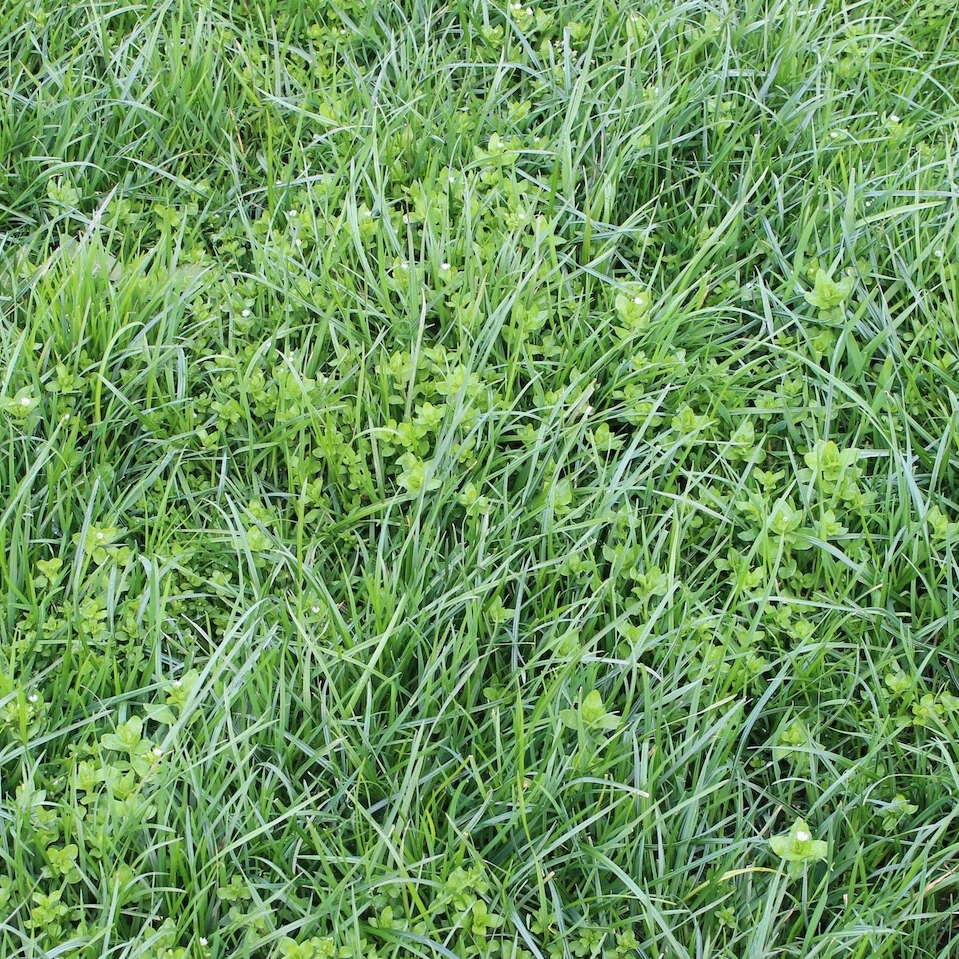 Common chickweed
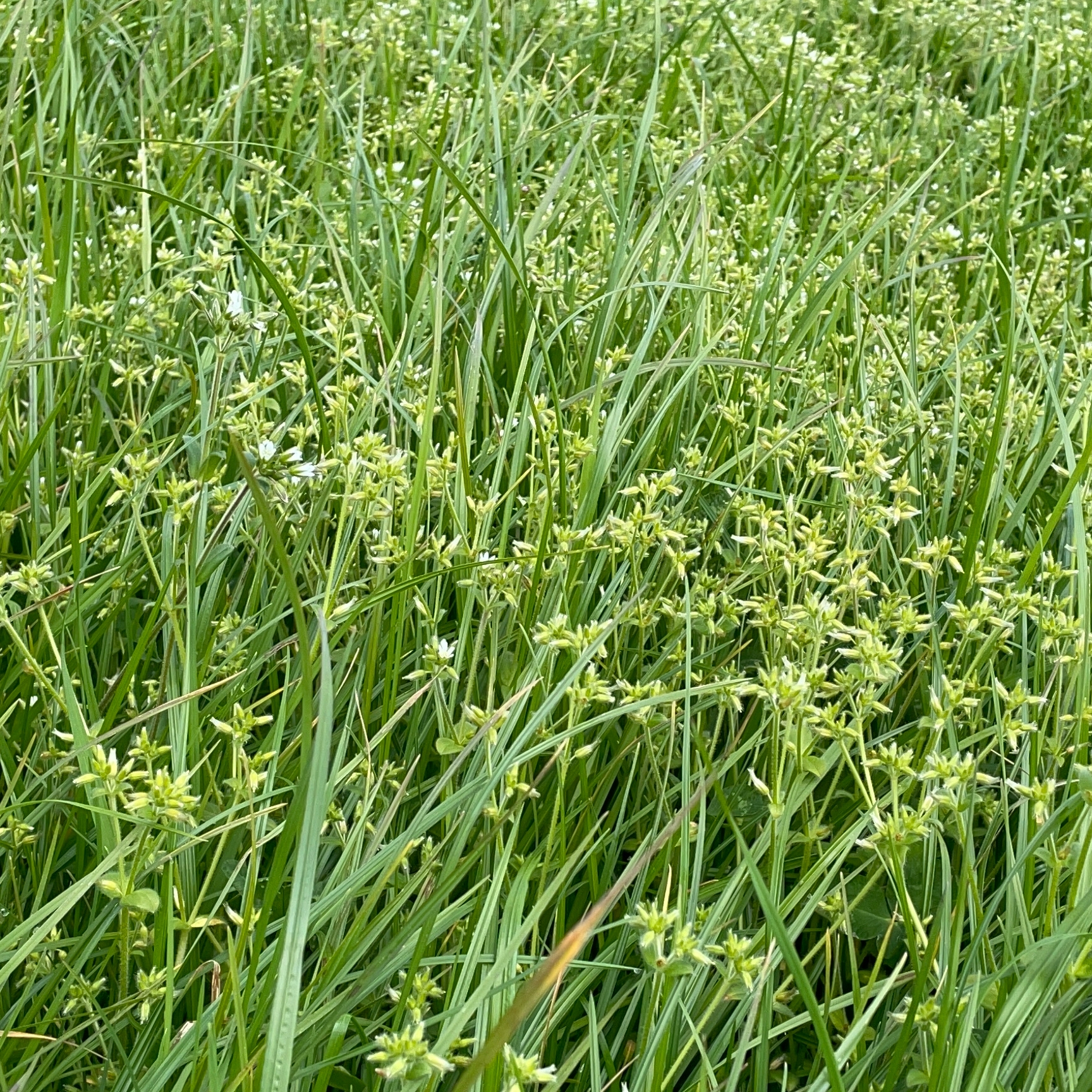 Mouse eared chickweed
Chickweed establishes quickly and easily in bare gaps in grass fields due to previous overgrazing, poaching, winter kill or frost damage. If left uncontrolled, this weed can quickly spread and significantly affect the productivity and quality of silage leys or pastures ear-marked for grazing. As it dies back it leaves even more open swards, which can lead to colonisation by docks.
“Chickweed loves to grow in cultivated ground or in open swards,” explains Ryan Came-Johnson, area manager for Corteva in the South of England, who also runs 200 breeding ewes at home in Devon.
“It is a low, ground-hugging weed with shallow roots and grows fast. This means it can easily smother young grass. Late summer or autumn re-seeds need checking now as it is particularly important to control chickweed populations before they start to outcompete the grass.
“There are two chickweed species, common and mouse-eared to look for. Both have the potential to cause issues but not all herbicide options control both. The other consideration is the presence of clover.
“Where clover presence is significant use ProClova® XL. This new product, introduced last year, has already proved itself with farmers keen to get rid of a range of unwanted weeds, but particularly chickweed.”
Available in a co-pack with 250g of ProClova and 500ml of XL adjuvant, this will treat three hectares (ha) of newly sown ley and can be applied between 1 April and 31 July, or two hectares when used on bigger chickweed plants growing in established grassland. This can be applied from 1 March to 31 October.
Ryan says “It is important to apply this product when temperatures are right. Application when overnight temperatures are low can cause reduced weed efficacy/clover safety. For optimum results, spray when overnight temperatures are forecast to be above 8°C for a period from three days before, to three days after proposed application date.
“Where clover presence is not a consideration, the best product is Envy®. Use at 1.5 litres/ha dose to control both common and moused-eared chickweed species. Unlike ProClova XL, it can be applied much earlier in the spring as temperatures are less critical. However, chickweed populations must be showing active growth before applying. Apply from 1 February though to 30 November.
.%20The%20untreated%20side%20has%20little%20grass%25252c%20bare%20patches%25252c%20and%20a%20lot%20of%20chickweed.jpg)
Comparison of untreated (left) vs treated with Envy (right)
About Corteva
Corteva, Inc. is a publicly traded, global pure-play agriculture company that provides farmers around the world with the most complete portfolio in the industry - including a balanced and diverse mix of seed, crop protection and digital solutions focused on maximising productivity to enhance yield and profitability. With some of the most recognised brands in agriculture and an industry-leading product and technology pipeline well positioned to drive growth, the company is committed to working with stakeholders throughout the food system as it fulfils its promise to enrich the lives of those who produce and those who consume, ensuring progress for generations to come. Corteva Agriscience became an independent public company on June 1, 2019, and was previously the Agriculture Division of DowDuPont. More information can be found at https://www.corteva.com/uk
Follow Corteva on Facebook, LinkedIn, Twitter and YouTube.
™ ® ℠ Trademarks and service marks of Corteva Agriscience and its affiliated companies.
Product information
ProClova contains florpyrauxifen-benzyl (Rinskor active) and amidosulfuron. XL adjuvant is an EC formulation containing 94% w/w fatty acid testers.
Envy contains fluroxypyr and florasulam.
Media Contact:
Sara Gregson
Sara Gregson Marketing Communications
t: 01799 530934 m: 07768 764062 e: sara@saragregson.co.uk