
Country Selector
Please enter a valid location
Stabilizing farm fields and community in Indiana

In central Indiana, just 30 miles northeast of Indianapolis, the Smith family has cared for their farm fields and the surrounding community of Pendleton for eight generations. But keeping the farm going for generations to come requires continued diversification and greater efficiency in daily operations.
“Our area has lost several thousand acres within the last 10 years from production agriculture,” says Neal Smith, co-owner of Smith Family Farms. “That’s why we’ve chosen to diversify more, because we’re losing a lot of ground to urban sprawl and development in this area.”
Rich history of farming
Smith Family Farms is approaching 200 years of continuous operation. President Andrew Jackson signed the original deed dated 1831. Deeply rooted in agriculture, the farm covers nearly 2,500 acres. Today, the family primarily focuses on raising corn and soybeans, with some acreage planted to wheat, while also raising cattle.
In the fall, the family runs a “you pick” pumpkin patch with a corn maze that entertains several thousand school children and educates them about farm life. The Smith family also partners with other local farmers to operate a butcher shop and deli, marketing their home-raised beef alongside other locally raised products like pork and chicken.
A key to the farm continuing to operate for nearly two centuries has been a shared family passion.
“Somebody in the family has always wanted to be involved in the farm — to come back home and keep the operation going,” Smith says. “It’s just the lifestyle and this community that we’ve always grown up in. The whole family is deeply rooted in the community.”
Smith now farms with his parents and two of his sons, and his wife helps run the butcher shop in town and the pumpkin patch.
Boosting crop yield
To keep Smith Family Farms thriving, maximizing the efficiency of every acre and input is essential for both profitability and long-term sustainability. That’s why fertilizing fields is a priority for the operation.
Before spring planting, the Smiths fertilize with anhydrous ammonia on the majority of their acres, and at planting they’ll apply some row-starter fertilizer. Fall is a busy time with agritourism, so applying fertilizer in the spring has worked best for their schedule, Smith says.
Depending on the weather, Smith Family Farms does occasionally implement sidedressing fertilizer.
“If we’ve got a nice-sized field that’s long and rectangular, we have done some sidedressing in that instance,” Smith says.
Preserving fertilizer investment
A nitrogen stabilizer is an important piece of ensuring fertilizer does its job each season by keeping nitrogen in ammonium form longer, so it is available to the plant during critical growth stages. N-Serve® nitrogen stabilizer celebrates a 50th anniversary in 2026, and it has been in use on Smith Family Farms for nearly the same amount of time, beginning with Smith’s grandfather.
“As long as we’re several weeks to a month preplant anhydrous, I don’t think there’s ever a reason that we would not continue to use N-Serve,” Smith says. “We’ve used it as long as I can remember, and it works.”
The price of anhydrous ammonia is rising, so using a nitrogen stabilizer helps the Smiths protect their fertilizer investment and maintain efficiency.
“Anhydrous just keeps getting more expensive, and so we want to keep it in the soil,” Smith says. “We like the flexibility that we have with preplant anhydrous. When everybody else is sidedressing, we’re planting pumpkins, baling hay, going to national junior shows and all those things that we like to do in the summer. We don’t want to lose that fertilizer. We want to keep it there until the crop actually needs it.”
Using N-Serve is stress-free for Smith Family Farms because the cooperative adds it to the anhydrous ammonia when a tank is picked up before application.
“Why wouldn’t you want to spend a few extra dollars to help ensure that fertilizer is there when you need it?” Smith says. “A nitrogen stabilizer can be good for the environment to stabilize nitrogen so it’s not leaching out or going into the atmosphere, but also just to protect that large investment.”
Do not fall-apply anhydrous ammonia south of Highway 16 in the state of Illinois. Always read and follow label directions.
Nitrogen Stabilizers Present Spring Application
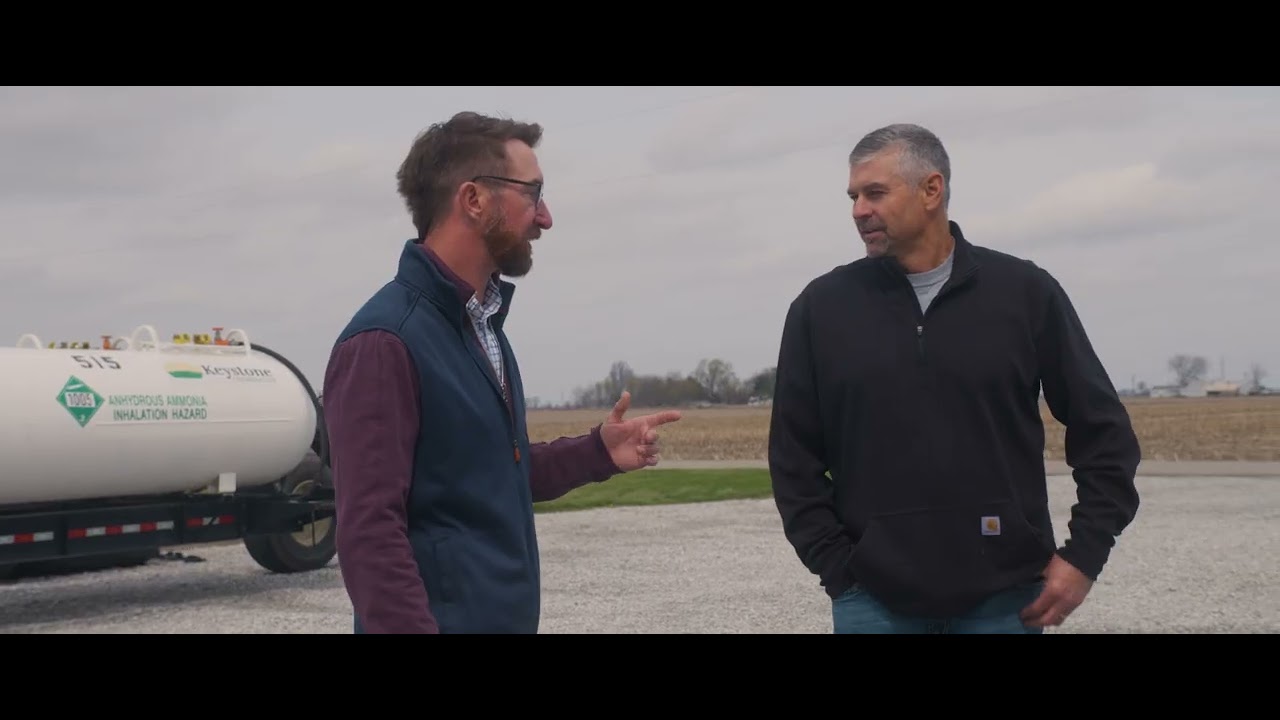
Join Tanner Winterhoff, @farm4profitpodcast host, as he talks with Neal Smith of Smith Family Farms in Pendleton, IN, about using N-Serve® Nitrogen Stabilizer on his spring fertilizer applications.
Nitrogen Stabilizers Present Spring Application
Join Tanner Winterhoff, @farm4profitpodcast host, as he talks with Neal Smith of Smith Family Farms in Pendleton, IN, about using N-Serve® Nitrogen Stabilizer on his spring fertilizer applications.
The More You Grow
Find expert insights on agronomics, crop protection, farm operations and more.