
Country Selector
Please enter a valid location
Celebrating Stewardship: 2026 ESAP Regional Winners

For generations, cattle producers have understood a simple truth: taking care of the land is essential to taking care of the cattle, the business and the generations that will follow.
The 2026 Environmental Stewardship Award Program (ESAP) regional winners are putting that principle into practice across remarkably different landscapes — from the rolling hills of Ohio and Tennessee to the brush country of South Texas and the high desert of Utah.
Established by the National Cattlemen’s Beef Association (NCBA) in 1991, ESAP recognizes cattle producers whose conservation efforts protect and improve natural resources while supporting economically sustainable cattle operations. The seven regional recipients are selected based on stewardship practices involving water, wildlife, vegetation, soil and other natural resources, as well as their leadership and the long-term sustainability of their operations.
For more than 30 years, Corteva Agriscience and its legacy companies have stood alongside the cattle industry as a sustaining sponsor of these elite awards. That long-standing commitment reflects a shared belief that cattle production and environmental stewardship go hand-in-hand — and that the producers doing exceptional work deserve to have their stories told.
Meet the seven cattle operations recognized as the 2026 ESAP regional winners.
Region I: LB Porteus Farms — Coshocton, Ohio
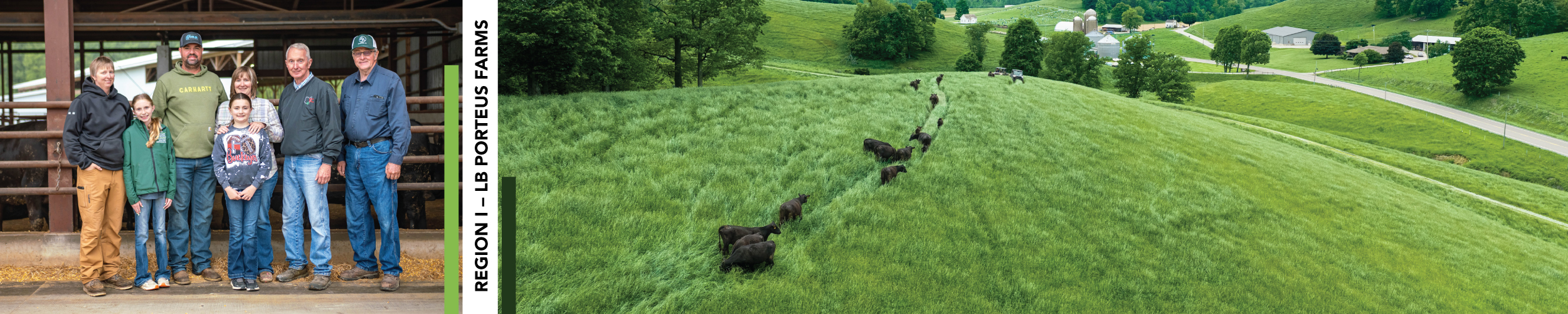
The Porteus family's roots in east-central Ohio's Muskingum River Valley reach back to the 1880s. Today, the fifth and sixth generations are carrying that legacy forward through a cattle and cropping operation built around economic viability, resource conservation, nutrient management, water quality and research-driven production practices.
Technology plays an important role. The family's 900-head-capacity feeding facility incorporates robotic and artificial intelligence-supported feeding as well as a unique manure storage system designed to increase nutrient content. Together, these advancements help reduce labor, energy use and the operation's emissions profile.
Stewardship at LB Porteus Farms, however, extends beyond the farm gate. The family actively shares its sustainability story with consumers and neighbors and invests in education and youth development — helping build a greater understanding of modern cattle production.
Region II: Donaldson Farms/D&D Meats — Celina, Tenn.
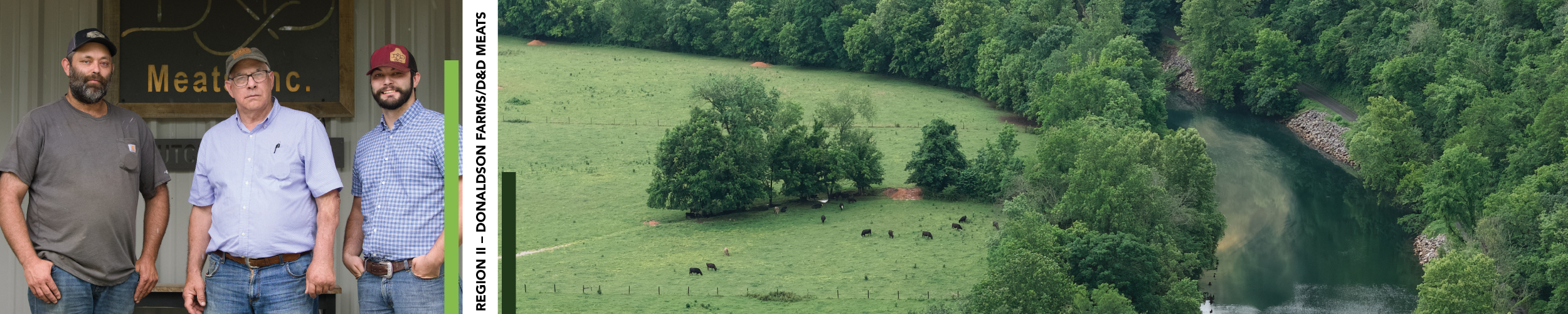
With agricultural roots dating to 1820, Donaldson Farms/D&D Meats has evolved into a vertically integrated operation encompassing cow-calf production, backgrounding and USDA-inspected processing.
The family's approach brings livestock management and natural resource stewardship together. Nutrient management, prescribed grazing, cover crops, and restricted livestock access to surface water help restore pasture productivity, protect riparian corridors, and improve grazing efficiency.
Those improvements serve another important objective: creating an operation capable of supporting another generation of the Donaldson family in agriculture.
Region III: Feikema Farms, Inc. — Luverne, Minn.
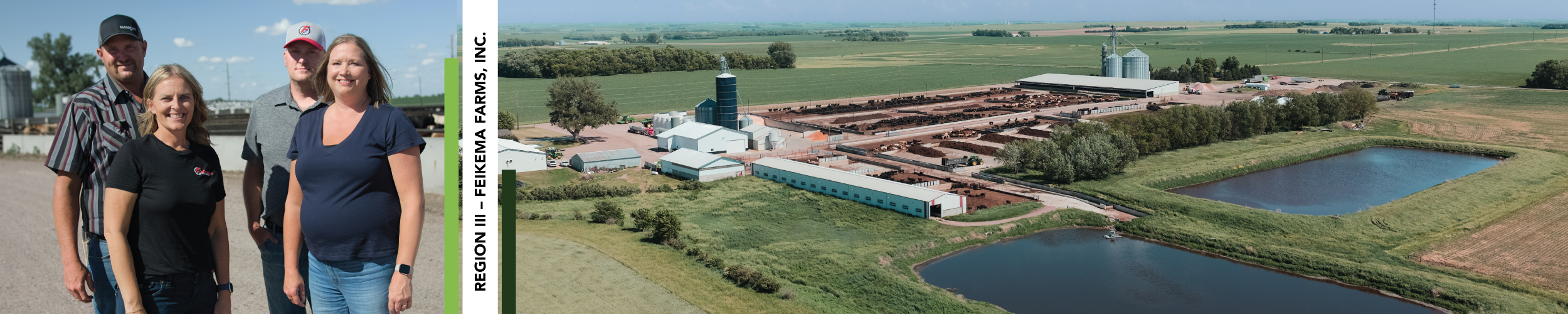
Feikema Farms began in 1950 as a small dairy and crop farm before transitioning to beef feeding when brothers Bob and Chuck Feikema returned home following their military service. Today, third-generation family members Shawn and Mike manage the 4,000-head-capacity feedlot.
A devastating 2014 flood became a turning point for the operation, highlighting the effects of runoff and erosion and prompting changes in how the family managed water, soil and nutrients.
The Feikemas subsequently implemented basins and tiling to protect waterways and reduce field erosion. They also began composting manure and using a large manure stacking pad. Today, the operation continues to focus on strong crop production and animal husbandry while building soil fertility, reducing erosion and developing long-term relationships with its partners.
Region IV: Bloody Buckets Cattle Company — Falfurrias, Texas
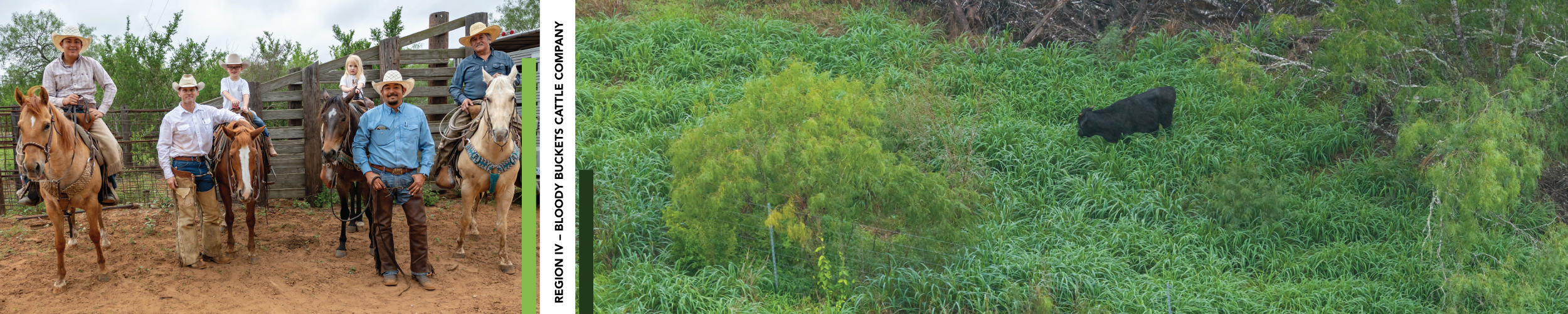
The story behind Bloody Buckets Cattle Company spans generations, with deep roots in both military service and stewardship of the land. The ranch's distinctive name honors the family's connection to the U.S. Army's 28th Infantry Division.
After serving during World War II, James "Jim" Clement worked for King Ranch before establishing Los Hermanos Ranch in 1963.
Today, James Clement III and his family partner with Dr. Alfonso Ortega Sr. and Dr. Poncho Ortega Jr. to manage 15,000 acres in the demanding South Texas brush country.
Their management philosophy puts long-term land health ahead of short-term production. Through restoration of degraded ground, adaptive grazing and strategic infrastructure investments, the families are creating a more resilient landscape that supports both cattle production and wildlife.
Region V: V Box Land and Livestock — Juntura, Ore.
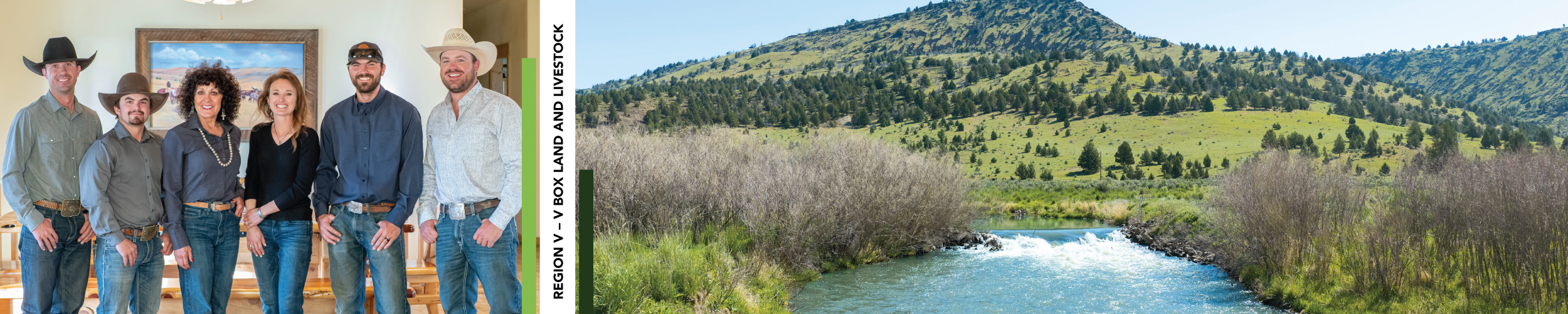
Mike and Linda Bentz built V Box Land and Livestock by combining four separate ranches into an operation encompassing nearly 28,000 private acres and 180,000 acres of public lands.
Following Mike's death in 2015, Linda and their five children continued the cow-calf operation — and its commitment to conservation.
Under Linda's leadership, more than 6,000 acres of western juniper have been removed and 16,000 acres of invasive annual grasses treated. The family has also restored 10,000 feet of riverbank and planted nearly 4,000 willows and native shrubs.
Those efforts have improved water quality and sage grouse habitat, reduced wildfire risk and strengthened long-term forage productivity. Today, the ranch has been divided into separate operations for the next generation, with all five Bentz children and their families continuing to ranch and carry forward their parents' conservation ethic.
Region VI: Munns Flying M Ranch — Snowville, Utah
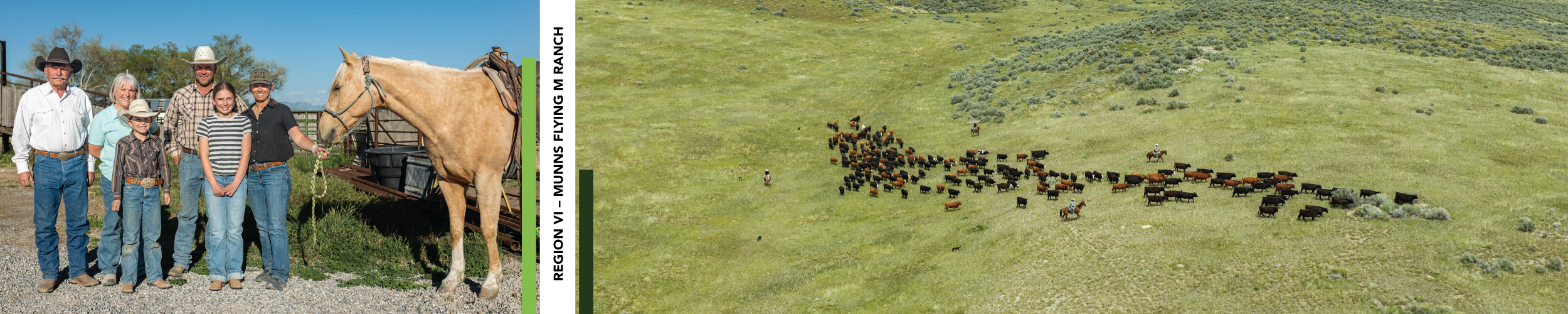
In the high desert of northern Utah, Tim and Laurie Munns have built a thriving cow-calf operation while working within one of the West's most challenging environments.
Munns Flying M Ranch includes 22,000 deeded acres, 5,000 acres of leased private land and additional grazing permits managed in partnership with government and tribal entities.
The family's stewardship strategy includes improving livestock water systems to better distribute cattle across the landscape, controlling noxious weeds and pests, managing brush and weeds to increase the perennial grass forage base, and collaborating with wildlife and land management agencies.
Continual learning and adaptation have helped the Munns reduce winter feed costs, improve plant vigor and strengthen overall rangeland health — creating benefits for wildlife habitat as well as the ranch's bottom line. The family also makes a point of sharing what it has learned with other producers and helping consumers understand the role cattle producers play as stewards of working lands.
Region VII: Stomprud Angus Ranch — Mud Butte, S.D.
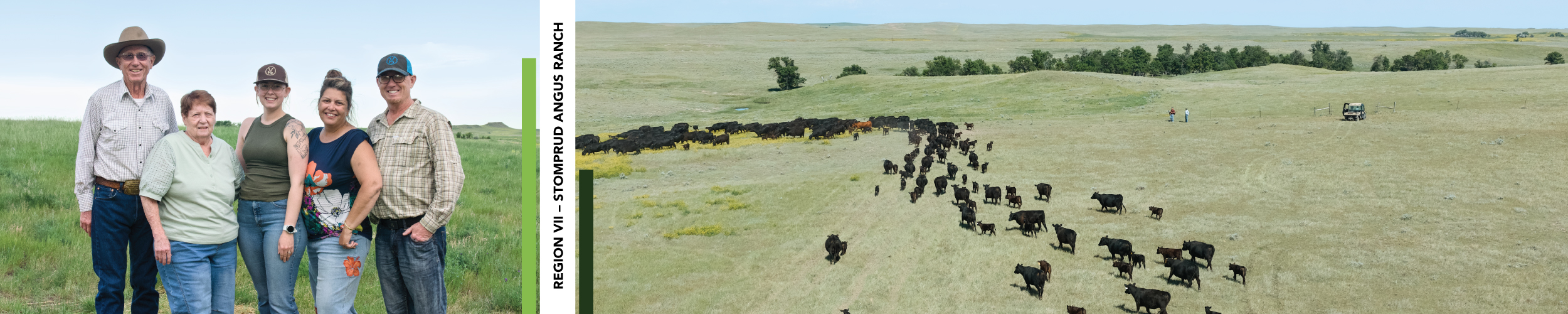
Established in 1909, Stomprud Angus Ranch is a multigenerational Angus cow-calf operation on the western South Dakota range.
Larry and Eileen Stomprud operate the ranch alongside their son Jay and daughter-in-law Jennifer, with help from their grandchildren. Together, three generations are working to ensure the land entrusted to them remains productive and resilient for those who come next.
Their approach to sustainability rests on three interconnected priorities: family, the environment and financial viability.
Rotational grazing provides grasses time to rest and rebuild root systems, while a deep-well pipeline distributes clean livestock water across the ranch and reduces pressure on creeks and riparian areas. Wildlife-friendly fencing allows antelope to move more freely across the landscape, and moving to a later calving season has helped reduce stress and feed requirements while improving calf health.
The result is a system designed to conserve water, protect habitat and maintain a healthy, functioning working prairie.
Celebrating More Than 30 Years of Stewardship
The landscapes may be different and the management practices unique to each operation, but the 2026 regional winners share something fundamental: a commitment to leaving the land better for the next generation.
That's been at the heart of ESAP since its establishment in 1991 — and at the heart of the support provided by Corteva Agriscience of the program for more than three decades.
As the program's longest-standing sponsor, Corteva is proud to help recognize cattle producers whose stewardship demonstrates that environmental responsibility and productive, profitable cattle operations aren't competing goals. At their best, they strengthen one another.
The seven 2026 regional recipients will now be considered for the National Environmental Stewardship Award. The national winner will be announced during CattleCon 2027 in Nashville, Tenn., in February.