
Country Selector
Please enter a valid location
Effective weed control in young wheat during dry conditions using technologies that deliver

Few things in wheat farming are as gratifying as seeing a high yield number pinging from the combine monitor screen.
A wheat crop’s yield potential is highest just after emergence, before environmental factors like weeds and pests induce stress and negatively impact that potential. That is why it is important to address those factors from planting to harvest to protect young spring wheat’s potential for a high-yielding crop.
As many of the spring wheat production regions across the United States continue to experience drought conditions, farmers will most likely find weeds emerging through residual applications not activated by rainfall.
“In this situation, a herbicide is needed that is effective, safe to use on wheat going through early growth stages and has a broad spectrum of control on both broadleaf weeds and grasses,” said Grant Harms, market development specialist, Corteva Agriscience. “It also needs to be tank-mix-friendly with other graminicides and herbicides.”
In drought conditions, frequent scouting is even more important to time applications for effective weed control.
“Once your stand of wheat becomes adequately established, schedule a herbicide application to protect it from weeds competing for any available ground moisture,” Harms said. “Weeds, in general, are more easily controlled when they’re in early growth stages, especially tough weeds such as kochia, buckwheat, and green and yellow foxtail.”
Growing degree days
A wheat crop’s emergence and subsequent development is driven by temperature. Tracking growing degree days (GDDs) can measure development more accurately than using a calendar.
“Different species of weeds require different GDDs to reach their various growth stages,” Harms said. “Kochia is a very early emerging broadleaf weed, typically emerging after 50 to 100 GDDs. It’s critical to make preplant, or very early preemergence applications, to hit that optimum control window.”
Emergence of troublesome grass weeds like green and yellow foxtail normally coincide with the emergence of spring wheat. Control measures should be targeted after the accumulation of between 150 and 300 GDDs.
“If not controlled, early season grasses can steal soil nutrients and available soil moisture spring wheat needs for robust development,” Harms said. “I’m seeing more wheat farmers adding Tolvera herbicide to their weed control programs for several reasons, including for the effective control it offers on so many tough broadleaf and grass weeds.”
Tolvera® herbicide is labeled for control of the most relentless broadleaf and grass weeds impacting wheat, durum and barley production today. Introduced in 2025, Tolvera herbicide packs two modes of action: bromoxynil and tolpyralate, an active ingredient new to the cereals market.
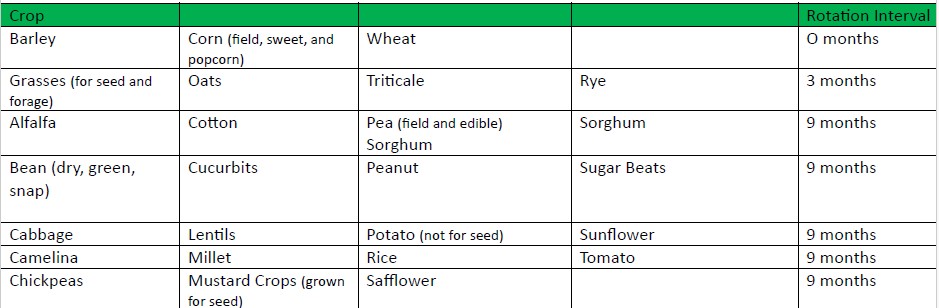
“Bringing two actives, a Group 6 and a Group 27, gives cereal farmers an effective herbicide to help combat the spread of resistant weeds while providing wider application flexibility and more crop rotation options to other key crops,” Harms said.
Additional considerations
- Use the high rate when weeds are stressed, growth stage is more advanced or populations are heavy.
- For both ground and aerial applications, be sure wind speeds are between 2 and 10 mph.
- Optimize efficacy by spraying with an adjuvant. See label for recommendations.
“Controlling tough weeds in young spring wheat when soil moisture is limited requires using tools that deliver information and crop protection technologies that deliver effective weed control,” Harms said. “Tolvera herbicide is one of those technologies. It provides the weed control farmers need in cereals, opens the rotational door to other major crops that could increase profit potential and is tank-mix-friendly with other products in the Corteva portfolio, such as OpenSky herbicide, Pixxaro EC herbicide with Arylex active, and Rezuvant herbicide.”
To learn more about Tolvera herbicide or the complete portfolio of Corteva Agriscience crop protection solutions, visit Corteva.com/Tolvera or talk with your local Corteva Agriscience sales representative.
OpenSky ®, Pixxaro ®, Rezuvant® and Tolvera® are not registered for sale or use in all states. Contact your state pesticide regulatory agency to determine if a product is registered for sale or use in your state. Arylex® is a registered active ingredient. Always read and follow label directions.
The More You Grow
Find expert insights on agronomics, crop protection, farm operations and more.