
Country Selector
Please enter a valid location
Spotting and Managing Tar Spot in Corn
Tar spot is a foliar disease of corn that has recently emerged as an economic concern for corn production in the Midwestern U.S. It is not a new disease, having been first identified in 1904 in high valleys in Mexico. Historically, tar spot’s range was limited to high elevations in cool, humid areas in Latin America, but it has now spread to South American tropics and parts of North America. It first appeared in the U.S. in 2015. During the first few years of its presence in the U.S., tar spot appeared to be a minor cosmetic disease that was not likely to affect corn yield. However, widespread outbreaks of severe tar spot in multiple states in 2018 proved that it has the potential to cause a significant economic impact.
Management tips
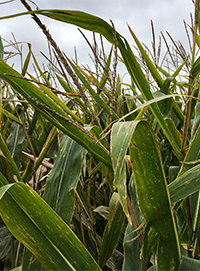 With its very limited history in the U.S., much remains to be learned about the long-term economic importance of this disease and best management practices. The pathogen that causes tar spot overwinters in corn residue but to what extent the amount of residue on the soil surface in a field affects disease severity the following year is unknown. Spores are known to disperse up to 800 feet, so rotation or tillage practices that reduce corn residue in a field may be negated by spores moving in from neighboring fields. Observations so far suggest that rotation and tillage probably have little effect on tar spot severity.
Duration of leaf surface wetness appears to be a key factor in the development and spread of tar spot. Farmers with irrigated corn in areas affected by tar spot have experimented with irrigating at night to reduce the duration of leaf wetness, although the potential effectiveness of this practice to reduce tar spot has not yet been determined.
Scouting and satellite imagery can be useful tools to identify areas of stress and confirm tar spot infection. Additionally, fungicides are shown to improve crop health and yield. Corteva Agriscience offers effective, fast-acting fungicides that can help protect against and mitigate tar spot infection. Aproach® Prima fungicide offers dependable disease control by quickly penetrating plant tissue to protect crop health and maximize productivity. Forcivo™ fungicide helps protect your crop with up to 30 days of residual control, giving you a powerful disease management tool that bolsters plant health and yield potential.
Impact on yield
Significant yield losses may occur from poorly filled kernels and reduced stalk quality resulting in increased lodging-induced harvest losses.
Symptoms
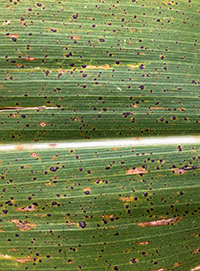
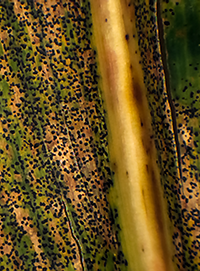 Tar spot is the physical manifestation of fungal fruiting bodies, the ascomata, developing on the leaf. The ascomata look like spots of tar, developing black oval or circular lesions on the corn leaf. The texture of the leaf becomes bumpy and uneven when the fruiting bodies are present. These black structures can densely cover the leaf and may resemble the pustules of rust fungi. Tar spot spreads from the lowest leaves to the upper leaves, leaf sheathes, and eventually the husks of the developing ears.
Timing/conditions for development
Tar spot is favored by cool temperatures (60-70 ºF, 16-20 ºC), high relative humidity (>75%), frequent cloudy days, and 7+ hours of dew at night. Tar spot is polycyclic and can continue to produce spores and spread to new plants as long as environmental conditions are favorable.
Aproach® Prima and Forcivo™ are not registered for sale or use in all states. Contact your state pesticide regulatory agency to determine if a product is registered for sale or use in your state. Always read and follow label directions.