
Country Selector
Please enter a valid location
Corn Insect Pests vs. the Evolution of Seed Technology

1996. That may seem like long ago to some, but for others it’s a time they remember well. A turning point in the seed industry and a season when farmers discovered what Bt corn traits could do for farming. What’s changed since then? A lot. And, also, not a lot. Some of the worst corn insect pests remain and they show no signs of letting up. They’re out there, lying in wait, emerging and chewing up profits and productivity faster than green grass through a goose. But that’s not to say we haven’t gained some ground. In fact, the results from Bt corn traits have been nothing short of revolutionary. And as the industry continues to evolve, so too does the pursuit of keeping these pests in check. Let’s take a closer look at some of the worst corn insect pests, the seed technologies available today to protect against them and new technologies slated for the future.
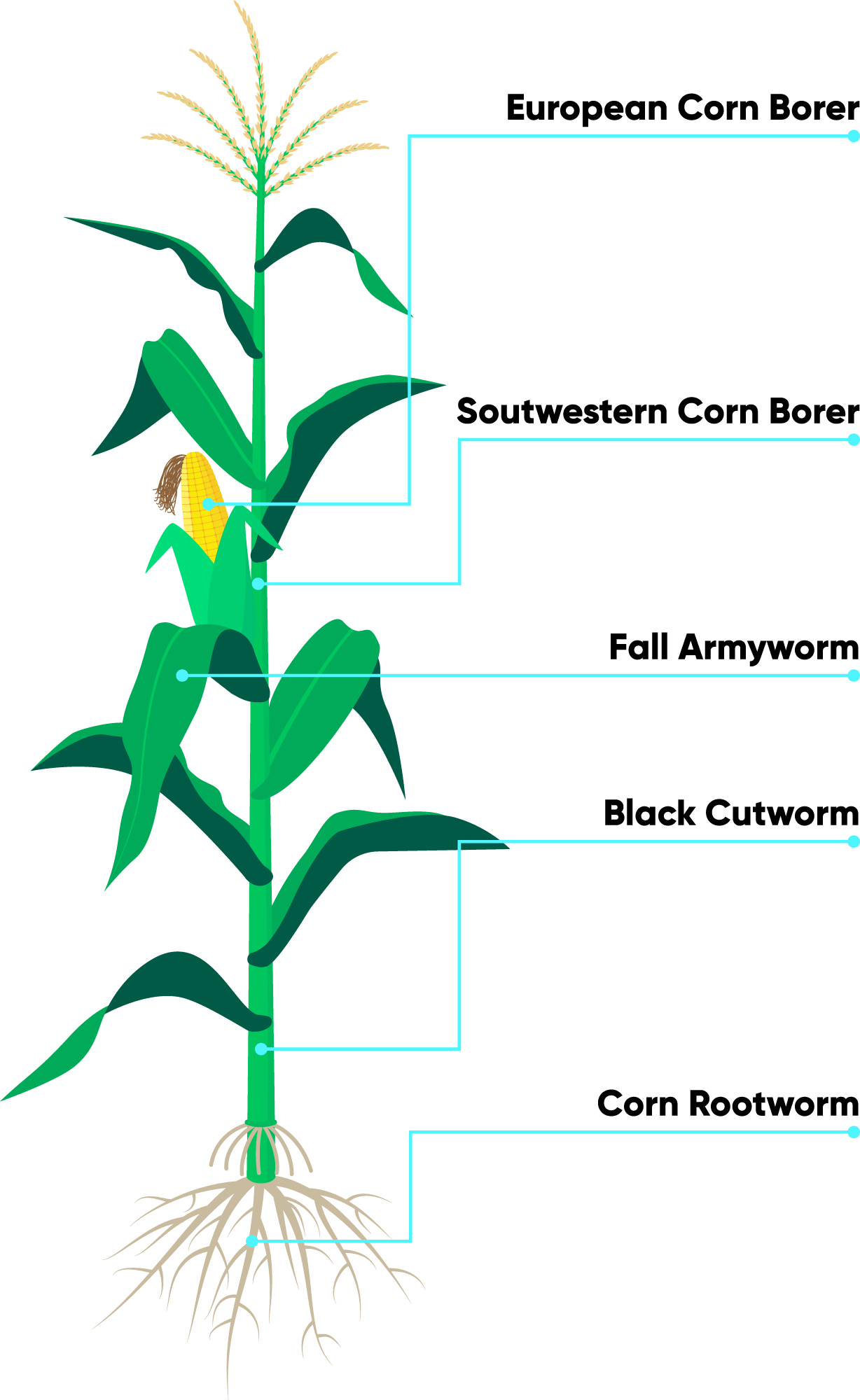
ABOVE-GROUND PESTS
European corn borer
- Corn borers tunnel into stalks and ears, making the plant susceptible to secondary insects and pathogens, which can cause stalk and ear rot later.
- Damage from boring can cause the plant to weaken and the stalk to break off below the ear at a later point.
- Boring into ear shanks can cause ears to detach from the plant.
- Yield losses may result from boring that leads to stunted corn or larvae that feed on kernels and cob.
Southwestern corn borer
- Young larvae feed on whorl leaves, making pinholes. Large larvae create bigger, elongated holes.
- Older larvae bore into stalks, which restricts the plant’s intake of water and nutrients, reducing both ear size and yield.
- Stalk lodging results from larvae girdling stalks as they prepare to overwinter.
Fall armyworm
- Larvae are capable of causing serious damage by feeding on whorl leaves.
- At the silking stage, larvae may feed on and destroy tassels and leaves.
- Developing kernels in ears may be damaged by feeding larvae.
Black cutworm
- Young larvae feed on corn leaves, creating holes but not causing significant damage.
- Large black cutworm larvae cause the damage for which they are named — typically cutting plants at or below the soil surface. One larva can destroy up to 4 to 5 corn plants in a lifetime.
- Large larvae bore into the stems of plants too big to cut. This boring can injure the growing point or disrupt water and nutrient flow, leading to the plant’s death.
BELOW-GROUND PESTS
Corn rootworm (northern & western)
- Larvae feed on root hairs and tissue and burrow into roots.
- Damaged or severed roots reduce water and nutrient uptake and lead to increased disease.
- Extensive damage can cause lodging and “goose necking,” making harvest more challenging.
Seed technologies today and in the future
In 2024, we opened up licensing access to one of the world’s largest corn germplasm pools through PowerCore® Enlist® corn. With strong genetics, three modes of action (MOA) against above-ground insect pests and four herbicide tolerances, it wasn’t long before PowerCore Enlist corn became one of the fastestgrowing above-ground traits. More recently, we announced we’ll expand the corn licensing portfolio with the introduction of Qrome® corn technology beginning in 2027, providing an additional solution for below-ground insect protection with two MOAs against corn rootworm, plus a 6 bu/A yield advantage over competitive SmartStax® technology.1 With limited availability in 2027 and broader commercialization planned in 2028, the excitement for Qrome products has already pushed demand forecasts beyond expectations.
All this innovation coming to the licensing market has been exciting, but it also may make you wonder, “What could the future hold for independent seed companies? And what will a corn product from Corteva Agriscience look like in the next 5-10 years?" One thing is for certain, strong corn genetics will continue to be in the driver’s seat. Riding shotgun? Here’s a snapshot:
- Yield and Yield Stability (YYS) – the industry’s first biotech trait focused on yield. This proprietary technology leads to seedling vigor, enhanced grain fill under stress and overall improved yield under normal and stressed conditions. YYS works across genetics and environments, offering a potential average yield increase of 3 bu/A with some locations showing a 10 bu/A advantage.2
- Multiple modes of herbicide tolerance – to help keep weeds under control.
- Above-ground protection – insect control traits projected to provide the longest lasting durability against key pests.
- Below-ground protection – two new proprietary below-ground insect control traits to help fight corn rootworm resistance.
- Multi-disease resistance (MDR) – protection against several major corn diseases, including northern corn leaf blight, southern rust, gray leaf spot and anthracnose stalk rot.
- Reduced stature corn (RSC) – protection from wind and stalk lodging.
Corn insect pests will likely always be a thorn in the side of farming. They’ll continue to evolve and so will we. Our germplasm will continue to get better each year, as it always has. We’ll continue to innovate, with seed technologies designed to push productivity to new heights. And we’ll continue to be by your side, supporting you and your customers with the tools needed to adapt to what the future has in store.
1 Qrome product performance based on the average of comparisons made in the U.S. 2019-2025. Comparisons are against DeKalb/Channel SSTX, segment matched.
2 AG099 was evaluated in 284 location x year combinations across 11 years in 95–118 CRM range.

™ ® Trademarks of Corteva Agriscience and its affiliated companies.
POWERCORE® is a registered trademark of Bayer Group. POWERCORE® multi-event technology developed by Corteva Agriscience and Monsanto. Always follow IRM, grain marketing and all other stewardship practices and pesticide label directions. B.t. products may not yet be registered in all states. Check with your seed representative for the registration status in your state. Enlist Duo® and Enlist One® herbicides with Colex-D® technology are the only herbicides containing 2,4-D that are authorized for preemergence and postemergence use with Enlist® crops. Enlist Duo and Enlist One herbicides are not registered for use or sale in all states and counties; are not registered in AK, CA, CT, HI, ID, MA, ME, MT, NH, NV, OR, RI, UT, VT, WA and WY. Contact your state pesticide regulatory agency if you have questions about the registration status of Enlist® herbicides in your area. ALWAYS READ AND FOLLOW PESTICIDE LABEL DIRECTIONS. ONLY USE FORMULATIONS THAT ARE SPECIFICALLY LABELED FOR SUCH USE IN THE STATE AND COUNTY OF APPLICATION. USE OF PESTICIDE PRODUCTS, INCLUDING, WITHOUT LIMITATION, 2,4-D-CONTAINING PRODUCTS NOT AUTHORIZED FOR USE WITH ENLIST CROPS, MAY RESULT IN OFF-TARGET DAMAGE TO SENSITIVE CROPS/AREAS AND/OR SUSCEPTIBLE PLANTS. Additional product-specific stewardship requirements for Enlist crops, including the Enlist Product Use Guide, can be found at www.traitstewardship.com. LibertyLink® and the Water Droplet Design are registered trademarks of BASF. Roundup®, Roundup Ready®, SmartStax® and the SmartStax Logo are registered trademarks of Bayer Group. SmartStax® multi-event technology developed by Corteva Agriscience and Bayer Group. © 2026 Corteva. 034065 LC (05/26)
