
Country Selector
Please enter a valid location
A Crop Expert Talks Farming and Climate Shifts

Weather always figures into farmer conversations, but in recent years, talk has turned to temperature extremes, wind events, excess rain and drought. These events seem to have increased, with some predicting dire consequences to crop production. In spite of this, crop yields have continued to increase over the last 40 years. So, what’s the real story? Is farming headed for insurmountable weather challenges, or are we better off than it seems? To find out more, we spoke with Jose Rotundo, a research scientist and weather crop expert at Corteva Agriscience. Based in Spain, Jose’s work combines historical climate analyses, crop growth modeling, long-term field trials and genetic experiments to help anticipate future production risks and opportunities across the U.S., Brazil, Europe and beyond. His insights into climate variables like heat extremes, moisture and increasingly lengthy frost-free periods will interest — and may even surprise — you.
cientists at Corteva, like Jose, have been tracking weather metrics for decades. Jose says that over the last 20-40 years, nighttime summer temperatures have increased almost everywhere globally, between 1.8 and 4.5 degrees fahrenheit. The number of extreme heat days — days with temps exceeding 95°F — has also increased in Brazil, southern Europe and the U.S. Globally, the most consistent trends have been warmer temperatures, especially at night, and longer frost-free periods. Rainfall trends vary greatly by region, including in the U.S., you can see significant differences between neighboring counties.
However, while it’s logical to think these observations would be a window into weather trends for all areas, Jose says they don’t paint a complete picture. “There is no single global weather trend or pattern that will equally apply to all areas across the U.S. Geographical and regional differences are important. Just because the number of extreme heat days are increasing globally, that doesn’t mean it’s happening everywhere. As an example, from 1980 to 2023, the number of extreme heat days in U.S. increased by 20 days. That’s significant. But the data shows this change is only occurring in 6% of crop growing areas. The same is true for extreme rainfall. It’s not everywhere, but there are areas where it’s increasing."
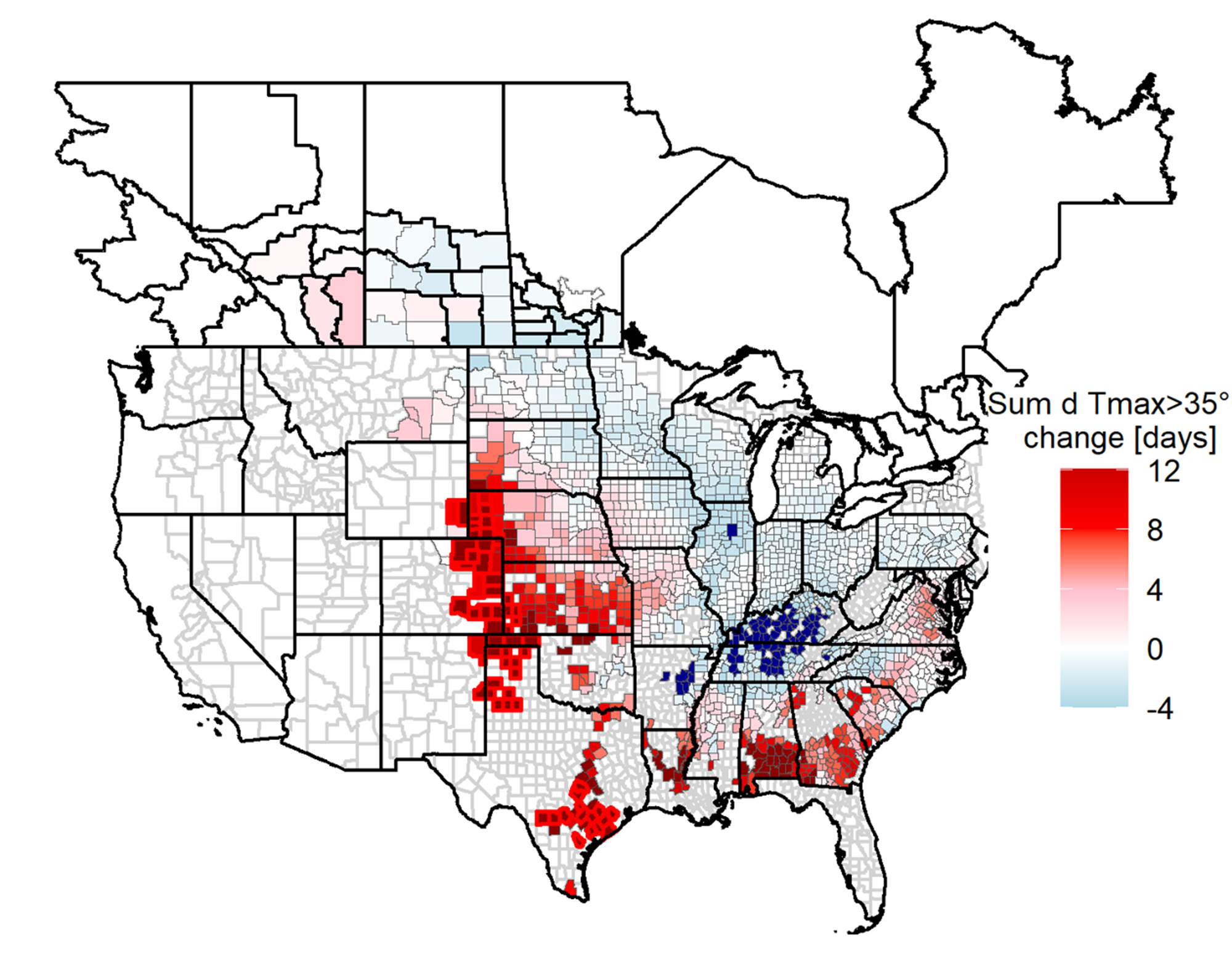 From 1980 to 2023, extreme heat days (above 95°F) in the U.S. increased by 20 days, but this only affected roughly 6% of crop-growing areas.
Of course, in areas with more extreme weather, farmers will face additional challenges such as increased heat stress during sensitive crop stages — like pollination and grain fill — and greater yield variability due to uneven rainfall. In addition, insect and disease pressures could increase as pests survive milder winters. However, Jose was quick to inform us that farmers could also see benefits with warmer temperatures. “A large area of the U.S. now has an average of 20 additional summer days for growing. These added days could allow for earlier planting, longer-season hybrids and double cropping. And in regions that were previously too cool to grow crops, moderate warming could create new farming areas. All this holds true only if rainfall does not become a limiting factor. Having longer growing seasons can’t be leveraged if there is no water.”
Despite the increase in temperatures and extreme heat days, the good news is that the basics of agronomy still apply. Jose says that “as far as the concept of heat stress damaging your crop, that’s true, but if you have water, you can basically grow corn everywhere. We have difficult growing conditions at our Woodland, California, research location, where it’s extremely hot, but with a suitable amount of water, we can still get record yields. Elite Replicated Agronomic trials across Iowa have shown yield gains of roughly 1.9% per year since 1980, driven almost entirely by genetics and agronomic management. Each of these two factors have contributed an equal share to the increase, whereas climatic trends have had a negligible impact.”
Keep in mind that, while there has been a lot of doom and gloom foretold, Corteva has been at work finding solutions to these new challenges. “The message about trends is important. But it’s not like everything is falling apart. Some very high-profile publications are saying that corn yield is going to be reduced 50% in the next 50 years,” says Jose. “When people read this sort of news, they start to get nervous, and that spurs us into action. We’re working hard, for the last 100 years, to create solutions that buffer against these issues, so the effects remain limited. For instance, we breed heat- and drought-resilient genetics and use crop models to test how they respond to climate and different management practices. We also run long-term trials to further quantify the genetic and management gains. These efforts have not only been effective in buffering against weather changes, they’ve also helped continually increase yields over the last 40 years — proof that what we’re doing works. As the future unfolds, breeding will continue to improve, agronomics will continue to improve and the management systems will evolve to meet these challenges.”
What’s Jose’s advice for U.S. corn and soybean farmers? “Plan for variability, not averages. Choose systems and products that perform consistently across a wide range of conditions. Make hybrid selections with broader stress tolerance. Incorporate a greater risk diversification with hybrid portfolios and crop rotations. Farmers may also consider adjusting planting dates to match longer frost-free periods as well as improving water and residue management. And keep things in perspective when it comes to weather trends. Yes, trends like gradual warming and weather unpredictability have been increasing in certain crop regions, but overall yields are increasing. And Corteva has no plans to stop innovating, testing and adapting to continue that pace.”
