
Country Selector
Please enter a valid location
What to Know About Fall Armyworm Pressure in Corn

Fall armyworm pressure can build fast. In just a few days, this migratory pest can shred young corn leaves, stunt plant development and chip away at yield potential before many growers even know it's there. In 2024, fall armyworm was responsible for more than 463,000 bushels of corn yield loss across the U.S., and populations continue to expand into new corn-growing regions.1
Fall armyworm is a pest that may go unnoticed with early “windshield” scouting. By the time ragged leaves begin unfurling from the whorl, larvae may already be well established and feeding aggressively. In severe infestations, fields can go from scattered feeding injury to heavy defoliation within days.
Understanding its life cycle can help growers identify and manage fall armyworms, protecting their bottom lines and reducing damage.
What is a fall armyworm?
Fall armyworm is a migratory moth that feeds on grasses and grain crops during its larval stage. Caterpillars are best identified by the inverted “Y” marking on the head capsule and four dark spots arranged in a square near the rear of the body. Larvae may range from green to brown and often have dark stripes running down the body.
Females lay egg masses on corn leaves and cover them with scales from their wings, giving the eggs a fuzzy or hairy appearance. Eggs can hatch in as little as three days under warm conditions. Larvae pass through six growth stages over roughly 15 - 18 days, depending on the time of year and temperatures, eventually reaching about 1¼ - 1½ inches long. Young larvae feed on tender leaf tissue before moving deeper into the whorl as they mature. Once fully grown, larvae move into the soil to pupate.
Adult moths migrate north from the Gulf Coast each year and may arrive in Corn Belt states from late June through early August. Because populations build over multiple generations, infestations can escalate rapidly during favorable weather conditions.
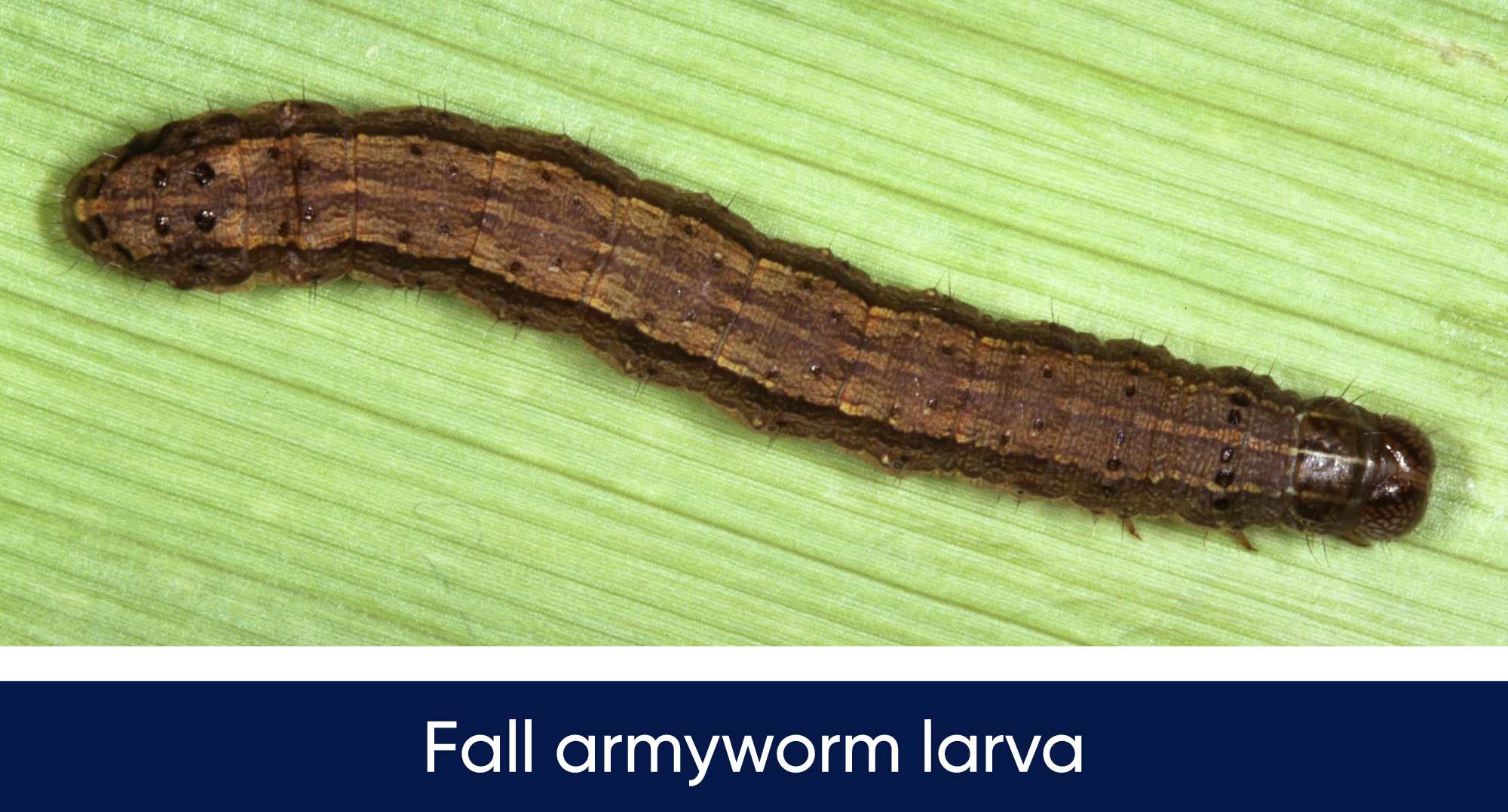
Symptoms of fall armyworm damage
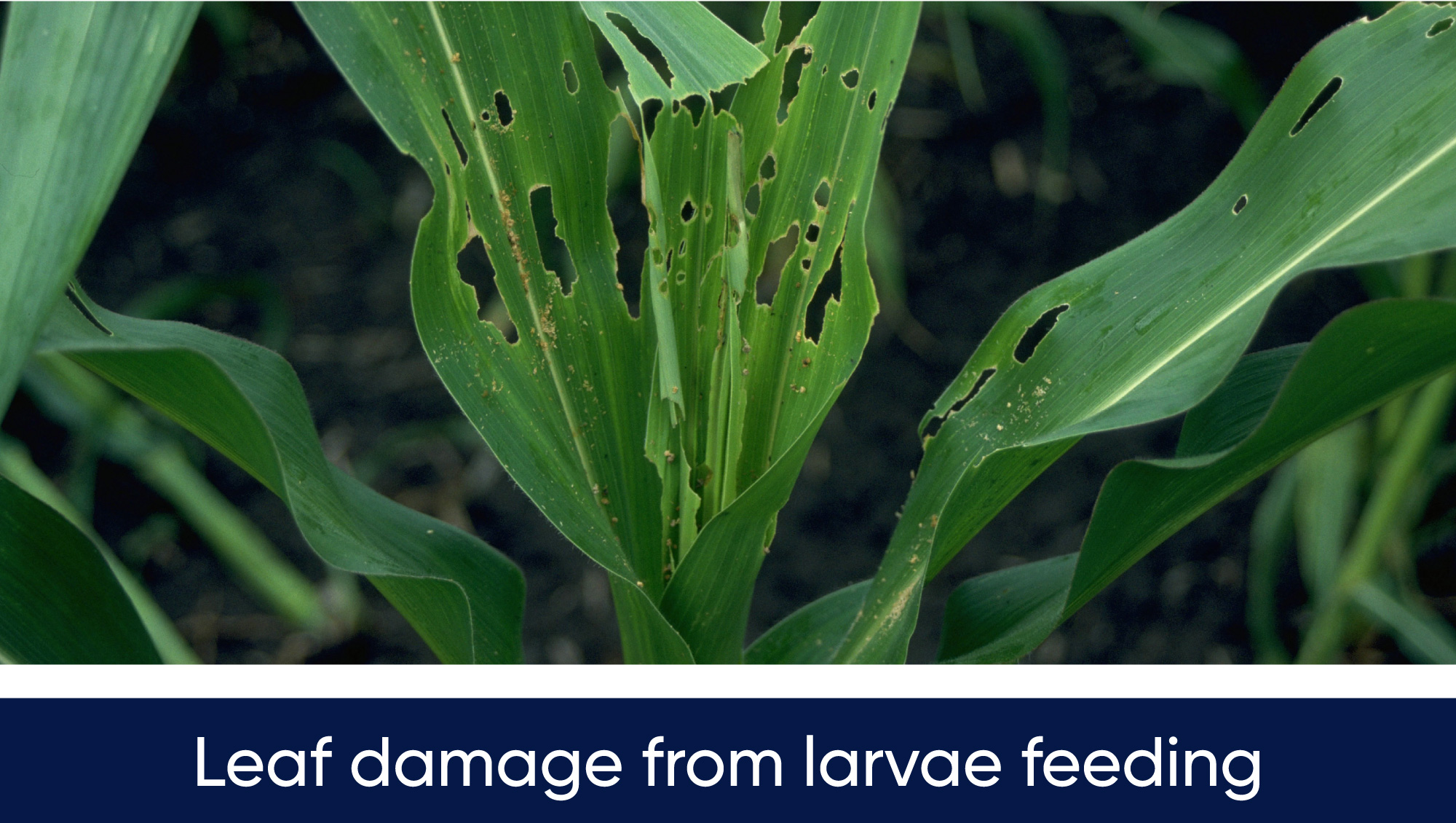
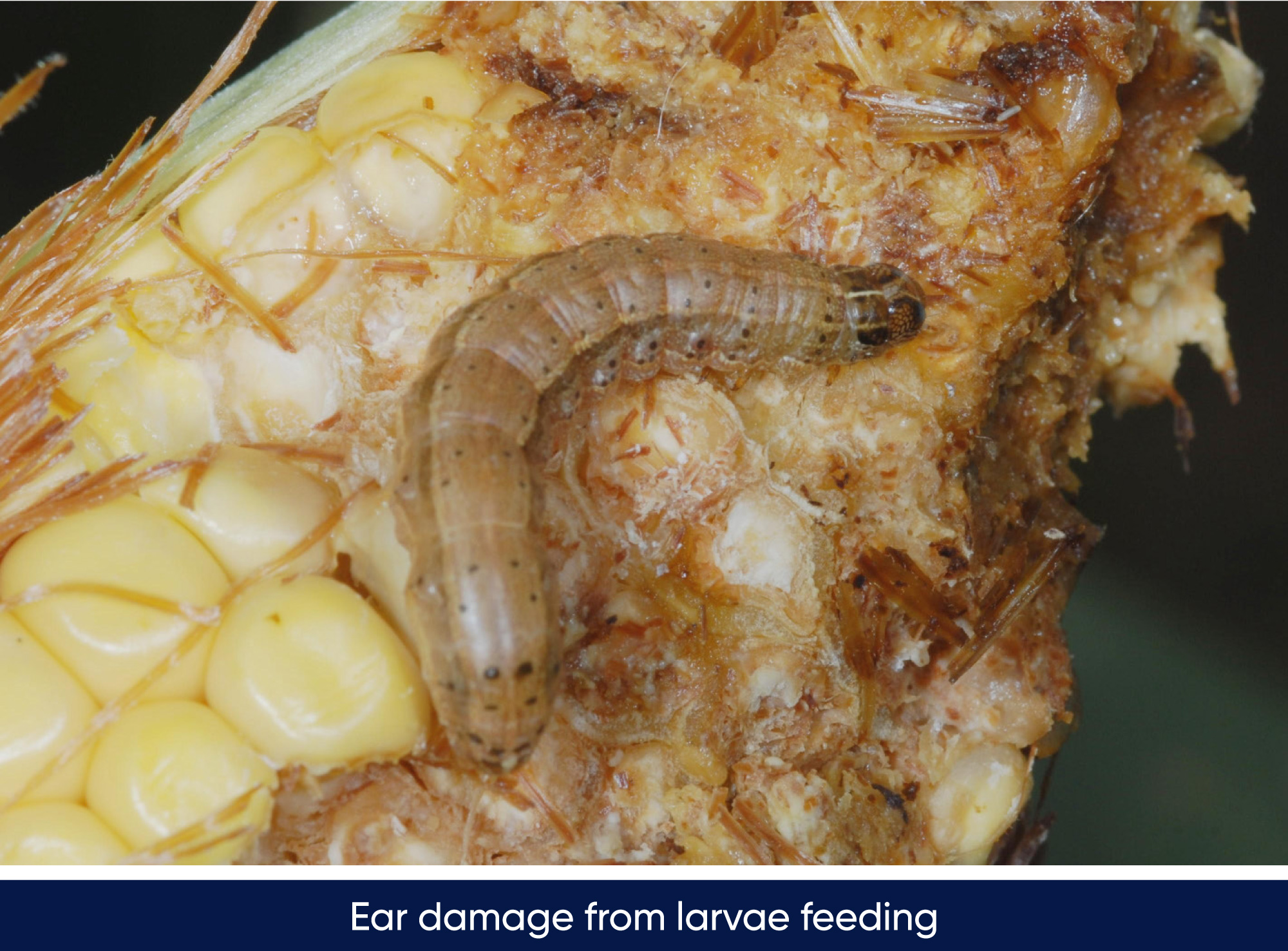
Fall armyworms primarily feed on corn foliage, and injury often begins deep inside the whorl before it becomes visible across the field. If infestations are heavy, they can damage corn ears, too. As damaged leaves unfurl, feeding appears as ragged holes, shredded leaf edges and rows of irregular chewing damage that can sometimes be mistaken for hail injury.
One of the earliest signs of infestation is “windowpane” feeding caused by young larvae scraping away leaf tissue while leaving the opposite side of the leaf intact. As caterpillars grow, feeding becomes much more aggressive. Larger larvae can consume significant amounts of leaf tissue in a short period of time, especially during warm weather when feeding activity increases.
Look for dropped frass or insect droppings in leaf whorls that often look like wet sawdust. In severe cases, plants may appear stripped or tattered across portions of the field. While fall armyworms primarily target leaves, large populations can also move into the ear later in the season and feed directly on kernels.
Other caterpillars, such as European corn borers, can cause similar damage. However, European corn borer larvae typically tunnel into stalks and stems, while fall armyworm larvae remain exposed on foliage and inside the whorl for much of their development. Corn is most vulnerable during early vegetative growth stages, particularly when plants are small and growing rapidly. Severe defoliation during these stages can reduce photosynthetic capacity, slow plant development and lower yield potential if infestations are left unmanaged.
Scouting tips
Growers should scout for fall armyworm from mid-June through early August, although infestations may appear earlier in more southern growing regions. Because adult moths migrate north throughout the summer, pressure can increase quickly during warm conditions.
Late-planted fields deserve the closest attention, as younger corn is typically more vulnerable to feeding injury. Corn planted after June 1 is often at greater risk for fall armyworm infestations, especially when moth flights coincide with warm, wet weather patterns.
Early detection is critical. Small larvae are easier to manage before they move deeper into the whorl, where larger caterpillars become more protected from insecticide contact and can consume significantly more foliage.
When scouting, inspect 20 consecutive plants in at least five different areas of the field. Look for fresh feeding injury, frass deep in the whorl, egg masses and live larvae. Treatment may be justified when 5% of plants contain egg masses or when 25% of plants show feeding injury or the presence of active larvae.
Management options
Managing fall armyworm starts with early detection and timely intervention.
Foliar insecticides can help reduce populations when economic thresholds are reached, particularly when applications are timed against smaller larvae. Good coverage is important, especially when caterpillars are feeding deep within the plant canopy. Continued scouting after treatment can also help determine whether additional management steps are necessary.
Trait technology can provide another layer of protection against above-ground feeding pests like fall armyworm. PowerCore® Enlist® corn contains multiple Bt proteins designed to help protect against caterpillar pests, including three modes of action against fall armyworm. This added protection can help reduce feeding injury during vulnerable growth stages and support more consistent plant development under pest pressure.
As fall armyworm pressure continues expanding into more corn-growing regions, early scouting and layered management strategies will remain critical for protecting yield potential. Recognizing infestations early, understanding when corn is most vulnerable and responding quickly can help reduce damage before populations become difficult to manage.
1 D. Reisig et al., “Corn Invertebrate Loss Estimates from the United States and Ontario, Canada — 2024,” Crop Protection Network, CPN-2019-24, doi.org/10.31274/cpn-20250224-1.

™ ® Trademarks of Corteva Agriscience and its affiliated companies.
POWERCORE® is a registered trademark of Bayer Group. POWERCORE® multi-event technology developed by Corteva Agriscience and Monsanto. Always follow IRM, grain marketing and all other stewardship practices and pesticide label directions. B.t. products may not yet be registered in all states. Check with your seed representative for the registration status in your state. Enlist Duo® and Enlist One® herbicides with Colex-D® technology are the only herbicides containing 2,4-D that are authorized for preemergence and postemergence use with Enlist® crops. Enlist Duo and Enlist One herbicides are not registered for use or sale in all states and counties; are not registered in AK, CA, CT, HI, ID, MA, ME, MT, NH, NV, OR, RI, UT, VT, WA and WY. Contact your state pesticide regulatory agency if you have questions about the registration status of Enlist® herbicides in your area. ALWAYS READ AND FOLLOW PESTICIDE LABEL DIRECTIONS. ONLY USE FORMULATIONS THAT ARE SPECIFICALLY LABELED FOR SUCH USE IN THE STATE AND COUNTY OF APPLICATION. USE OF PESTICIDE PRODUCTS, INCLUDING, WITHOUT LIMITATION, 2,4-D-CONTAINING PRODUCTS NOT AUTHORIZED FOR USE WITH ENLIST CROPS, MAY RESULT IN OFF-TARGET DAMAGE TO SENSITIVE CROPS/AREAS AND/OR SUSCEPTIBLE PLANTS. Additional productspecific stewardship requirements for Enlist crops, including the Enlist Product Use Guide, can be found at www.traitstewardship.com. LibertyLink® and the Water Droplet Design are registered trademarks of BASF. ®Roundup and Roundup Ready are registered trademarks of Bayer Group. © 2026 Corteva. 034070 LC (06/26)
