
Country Selector
Please enter a valid location
The Keys to Creating Brand Awareness

Ask any business if they want more awareness of their brand and they’ll say yes. Why? It’s pretty simple. Most businesses are trying to sell something, and it’s hard for audiences to buy when they’re not aware. So, awareness is essentially the first step in both the marketing and sales process. In the seed business, farmers tend to go through five steps before they ultimately buy and become good customers:
- Awareness: The farmer learns of the product but knows little or nothing about it beyond its existence and some idea of its benefits.
- Interest: The farmer becomes interested, seeks information and begins to gather details.
- Evaluation: The farmer imagines using the product, thinking about whether it might be a fit for their specific needs.
- Trial: The farmer experiments with the product on a small scale in an effort to become familiar with it and gauge its benefit and performance.
- Adoption: The farmer begins largescale use, which hopefully leads to preference, satisfaction and repeat purchases.
Before we dive deeper into brand awareness, let’s take a look at a hypothetical brand awareness campaign for a new seed treatment.
Example: Developing brand awareness for a new product
Suppose you add a brand-new seed treatment to your portfolio. In trials, it protects against Pythium better than any other seed treatment available. So, you get together with the marketing team and they develop a new creative campaign centered around the slogan “#1 against Pythium.” In the coming weeks, your digital ads, email blasts and social media become littered with the campaign. The boss steps in and asks whether it makes sense to change things up. The marketing team’s response? “Not yet.”
In the example above, why did the marketing team want to continue running the same creative campaign for weeks on end? They knew that frequency, repetition and consistency supercharge efforts to build awareness. How? Let’s take a closer look at each of these concepts:
Frequency — In marketing, frequency refers to the number of times a target audience encounters a specific message within a given period. A study originated by psychologist Hermann Ebbinghaus demonstrated that as message frequency increases, retention also increases.1 How much frequency do you need for people to remember your message? While there isn’t a single number that covers all marketing situations, research suggests it’s somewhere between 5-12 times.2
Repetition — Repetition is the strategic practice of delivering the same message multiple times. In our new product example above, the target audience received the “#1 against Pythium” message over and over via digital ads, email blasts and social media. Studies show that repetition can reinforce long-term memory by up to 35%.3 Note that, while repetition may sound similar to frequency, the two elements are different. You can repeat a message without it being frequent. For instance, if you ran the same digital ad once every year for five years, it would run repeatedly, but not frequently. Running the same ad every day for five weeks would be both frequent and repetitive — and much more likely to create awareness.
Consistency — Consistency reflects the uniform delivery of your message across various channels. Using the same slogan, “#1 against Pythium,” in all touchpoints of our example represents consistent messaging because it uniformly delivers the same message every time. Studies show that consistency in social media communication significantly influences brand awareness.4 Why does using these concepts to develop awareness matter so much? Because people forget a lot of information far more quickly than you’d think. And when they forget, they’re no longer aware.
The truth about forgetfulness
We joke about forgetfulness all the time, but it’s a real thing! Psychologist Hermann Ebbinghaus demonstrated that, within seven days, people forget 75% of new information they learn. After 30 days, they forget 95%.5 That means after a month — without the frequent, consistent, repeated messaging highlighted in our example on the previous page — your target audience remembers almost nothing about your message.
Can you build brand awareness without a big advertising budget?
In short, yes. Advertising, while one of the most efficient ways to build awareness, doesn’t represent the only method. You can build awareness through many forms of communication, like email, direct mail, social posts, phone calls, text messages and face-to-face selling. Just keep in mind, while you’re not paying media space costs for these communication vehicles, there’s still a cost associated with development and implementation, generally in the form of increased time and/or labor. A booth at your local 4-H fair or dropping in for a field visit are two such examples. Can you run a big ad campaign if you have the desire and budget? Of course. Just don’t get stuck thinking of it as the only way. Likely, you’ll find that layering paid ads on top of your other communication activities delivers the best results.
The curve of forgetfulness5
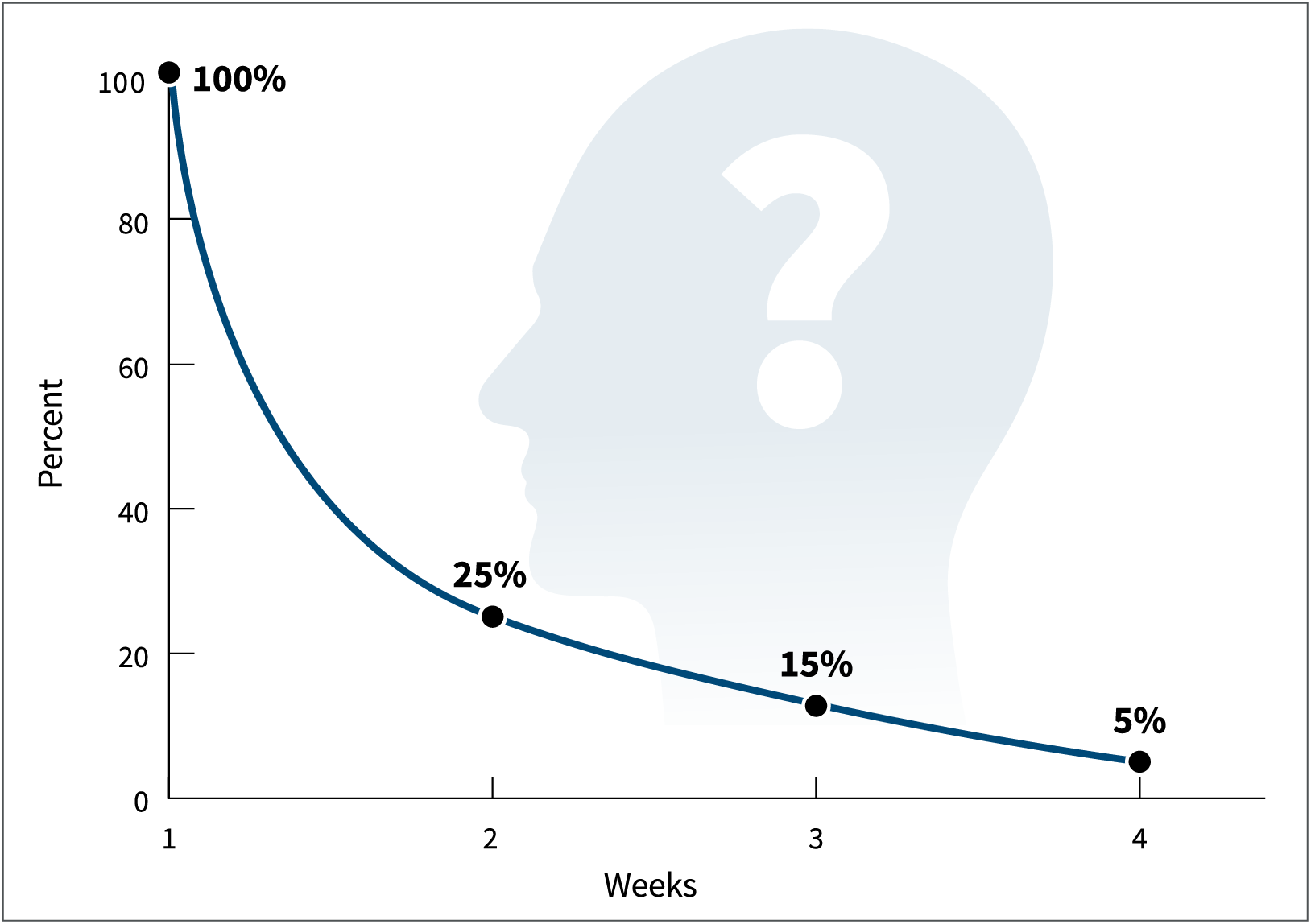
Research shows that without repeated exposure to new information learned, we remember only 25% of it after one week. After four weeks, we remember only 5% of the original information.
When launching a new product or promoting your company, leveraging the concepts of frequency, repetition and consistency can help build lasting brand awareness. And with awareness, you can then further accelerate your audience’s path to interest, evaluation, trial and, hopefully, adoption.
1 Jaap M. J. Murre and Joeri Dros, “Replication and Analysis of Ebbinghaus’ Forgetting Curve,” PLoS One 10, no. 7 (2015), https://pmc.ncbi.nlm.nih.gov/articles/PMC4492928/.
2 “The Power of Repetition in Communication: How Many Times Does It Take for a Message to Stick?,” It’s Relevant TV, Aug. 28, 2025, https://articles.itsrelevant.com/2025/08/28/power-repetitioncommunication-many-times-take-message-stick/.
3 Lindsay Plater et al., “Repetition enhances the effects of activated long-term memory,” Quarterly journal of experimental psychology 76, no. 3 (2022): 621–631, https://pmc.ncbi.nlm.nih.gov/articles/PMC9936439/.
4 I.D.G. Aristana et al., “The Influence of Consistent Social Media Communication on Brand Awareness of Ignos Studio's MSMEs,” Brilliant International Journal of Management and Tourism 5, no. 2 (2025), https://journalcenter.org/index.php/BIJMT/article/view/4922.
5 Colin McDonald, Advertising Reach and Frequency, (NTC Business Books 1996).
