
Country Selector
Please enter a valid location
Switching for Success: Inside the Decisions to Adopt the Enlist® Weed Control System

The Enlist® weed control system is winning over a lot of farmers, but sales numbers don’t tell the whole story. What are the real reasons farmers are making the switch? It’s always nice to hear things straight from the source, and with the Enlist weed control system — there’s a lot to talk about. From fighting resistance to low volatility to ease of use, farmers across the U.S. have something to say about it.
KEY PROBLEM: Herbicide resistance

Whether it’s Palmer amaranth, waterhemp, marestail or any number of other weeds, resistance is an ever-present battle for farmers. Grady Johnson of Nebraska was having so much trouble with herbicide resistance to Palmer amaranth, he said, “We hired rogueing crews to cut out the weeds, because that was the only option.”
Luke Liechty of Indiana faced a similar issue with a different weed, sharing, “The last couple years, waterhemp has been a huge issue for us. Waterhemp is just a nasty weed in general.”
Luke Anderson of North Dakota had issues with both weeds on his farm, revealing, “About five years ago, it became almost impossible to control weeds with one herbicide. Waterhemp pressure was bad, and the weeds were showing resistance. We kept throwing chemistries at the problem, but it didn’t work. At the same time, Palmer amaranth kept creeping closer to our farm. We were not prepared for it.”
Solutions:
Grady’s move to the Enlist weed control system provided him with the results he needed. He said, “When we switched to Enlist E3® soybeans, it was a night and day difference. The weeds were controlled and they weren’t going to become a bigger problem in years to come. With the Enlist system, the weed control is so good that we don’t have to think about it all of the time. Now we can focus more on pushing our yields even higher and being more profitable.”
Luke Liechty was no less pleased, saying, “The control Enlist Duo® herbicide provided was phenomenal.” He added that within a day, targeted weeds started to curl. Within two weeks, they had wilted beyond recovery. “The biggest value for the Enlist program on our farm is confidence,” he continued. “It’s confidence knowing that I can go out there and control weeds that are difficult to control right now.”
Luke Anderson appreciated the additional modes of action. He said, “The nice thing about the Enlist system is it gives us flexibility. We can use a program approach and get two more modes of action with Enlist Duo or with Enlist One® herbicide mixed with glufosinate. We may be able to skip glyphosate some years. It’s nice to have options to change chemistries as we need to for weed control.”
KEY PROBLEM: Dicamba volatility and drift
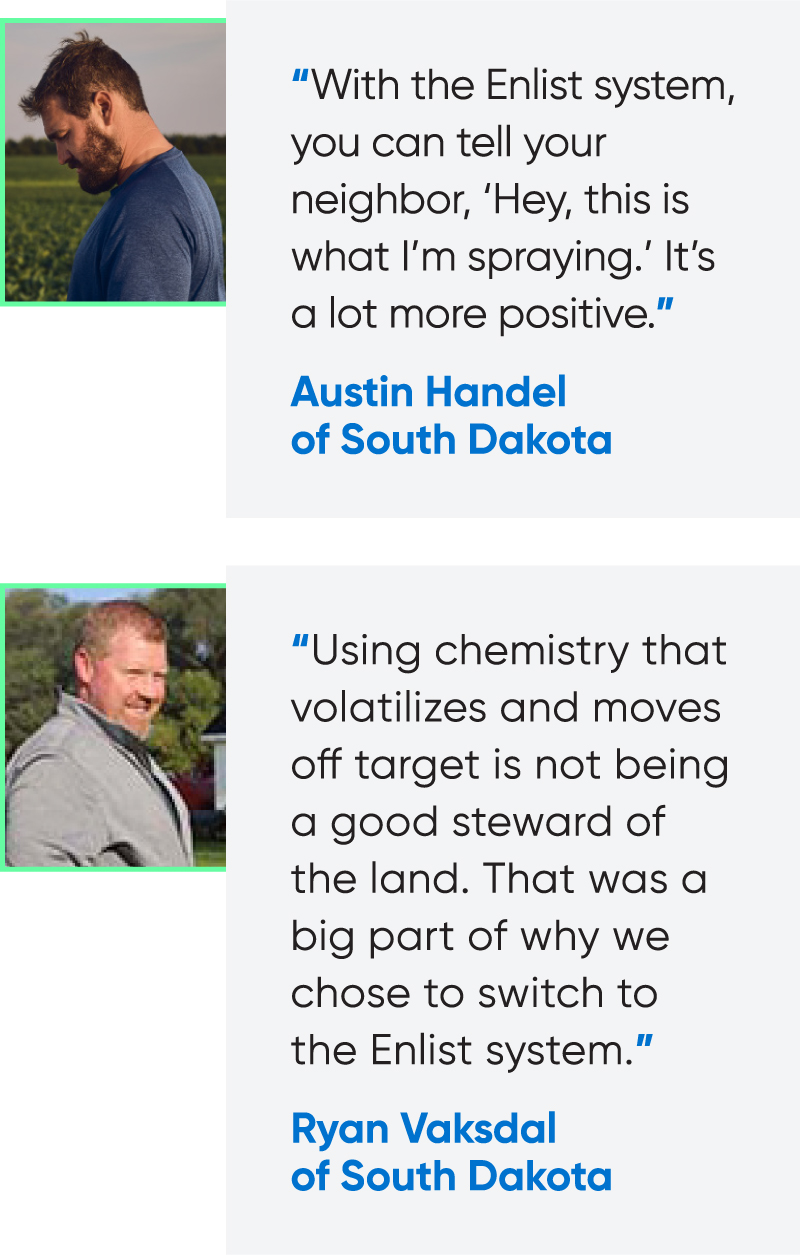
Austin Handel of South Dakota had issues with drifting and volatility despite his best efforts, revealing that, “Neighbors would just get mad that you were even spraying dicamba, even if you were doing everything right. It ended up hurting my wife’s garden pretty bad. I was completely on label. Everything was exactly as it should have been.”
Ryan Vaksdal of South Dakota had similar concerns, going to bed at night worrying he’d get a call from his neighbors, and decided, “I needed a game plan ready to handle those situations. That was too much of a hassle. I know a lot of guys don’t do that, but that’s not being a good steward. That’s not respecting your neighbors.”
Solutions:
The results were what Austin was looking for: “With the Enlist® weed control system, you can tell your neighbor, ‘Hey, this is what I’m spraying.’ It’s a lot more positive.”
Ryan performed a test, spraying a field that butted up against an alfalfa patch. “I had zero issues. I could spray right alongside of the alfalfa with a direct application, six inches away. There was zero damage,” he said. “Using chemistry that volatilizes and moves off target is not being a good steward of the land. That was a big part of why we chose to switch to the Enlist system.”
KEY PROBLEM: Dicamba application limitations
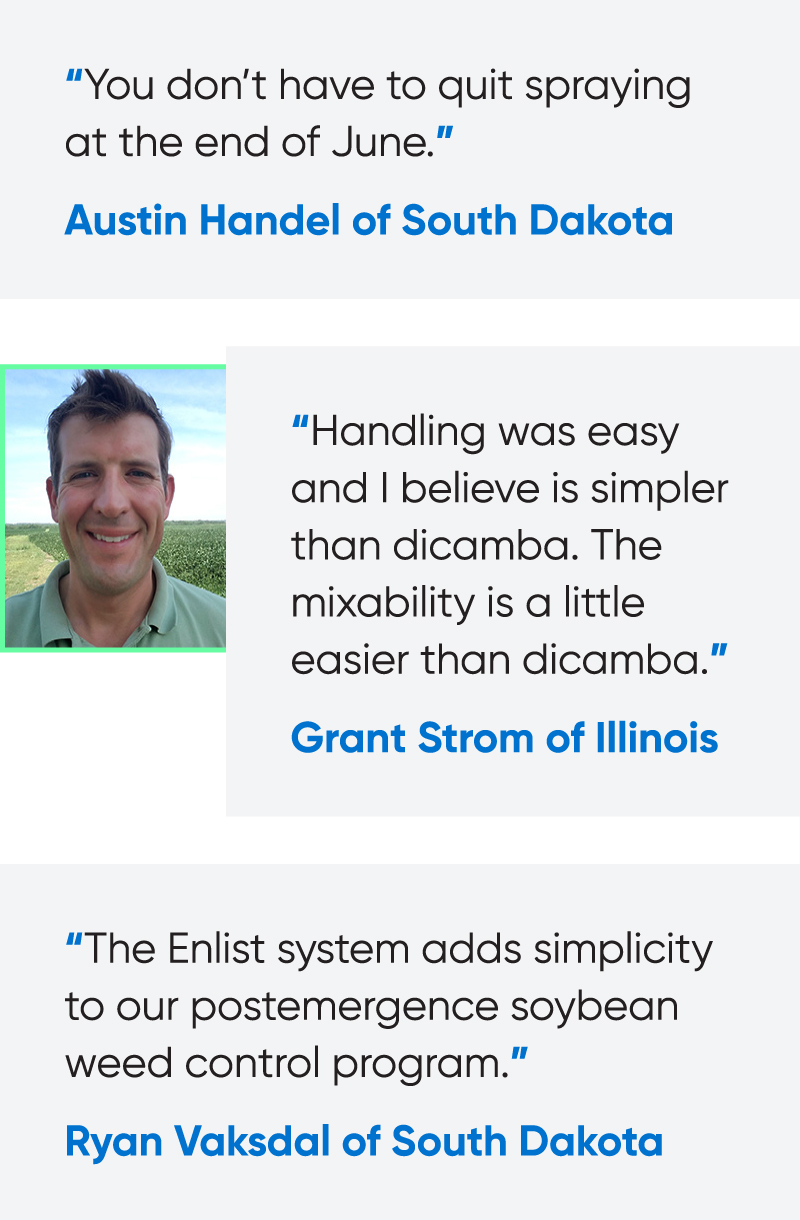
Weeds are enough of a problem on their own without adding the operational constraints some weed control systems require. Grant Strom of Illinois put it simply: “Dicamba controls weeds, but it’s a pain to use. The window of opportunity is so small with dicamba.”
Ryan echoed Grant’s thoughts, saying, “With the dicamba system, there are minimal days you can spray, which poses a challenge. In my opinion, the risk wasn’t worth the reward.”
Referring to his own previous method of weed management, Austin said, “You had no lateseason protection. And that does not help you at all.”
Solutions:
Austin welcomed the lack of calendar restrictions. “You don’t have to quit spraying at the end of June,” he said.
For Grant, the Enlist weed control system came with several advantages he valued, stating that, “It’s less volatile, the label is less stringent and it’s just as effective as dicamba on weeds. Handling was easy and I believe is simpler than dicamba. The mixability is a little easier than dicamba.”
Ryan appreciated how it helped streamline his work, noting, “It’s simpler to use than the other system. The Enlist system adds simplicity to our postemergence soybean weed control program. It’s very effective weed control, and it just works.”
Change doesn’t always come easily, and there are many variables to consider, but sometimes, the need makes itself known. If your customers come to you with some of the issues mentioned here, it’s probably time to think about switching to the Enlist weed control system.
™ ® Trademarks of Corteva Agriscience and its affiliated companies. The transgenic soybean event in Enlist E3® soybeans is jointly developed and owned by Corteva Agriscience and M.S. Technologies L.L.C. Following burndown, Enlist Duo® and Enlist One® herbicides with Colex-D® technology are the only herbicides containing 2,4-D that are authorized for preemergence and postemergence use with Enlist® crops. Consult Enlist® herbicide labels for weed species controlled. Enlist Duo and Enlist One herbicides are not registered for use or sale in all states and counties; are not registered in AK, CA, CT, HI, ID, MA, ME, MT, NH, NV, OR, RI, UT, VT, WA and WY; and have additional subcounty restrictions in AL, GA, TN and TX, while existing county restrictions still remain in FL. All users must check “Bulletins Live! Two” no earlier than six months before using Enlist One or Enlist Duo. To obtain “Bulletins,” consult epa.gov/espp/, call 1-844-447-3813, or email ESPP@epa.gov. You must use the “Bulletin” valid for the month and state and county in which Enlist One or Enlist Duo are being applied. Contact your state pesticide regulatory agency if you have questions about the registration status of Enlist® herbicides in your area. ALWAYS READ AND FOLLOW PESTICIDE LABEL DIRECTIONS. IT IS A VIOLATION OF FEDERAL AND STATE LAW TO USE ANY PESTICIDE PRODUCT OTHER THAN IN ACCORDANCE WITH ITS LABELING. ONLY USE FORMULATIONS THAT ARE SPECIFICALLY LABELED FOR SUCH USE IN THE STATE OF APPLICATION. USE OF PESTICIDE PRODUCTS, INCLUDING, WITHOUT LIMITATION, 2,4-D-CONTAINING PRODUCTS NOT AUTHORIZED FOR USE WITH ENLIST CROPS, MAY RESULT IN OFF-TARGET DAMAGE TO SENSITIVE CROPS/AREAS AND/OR SUSCEPTIBLE PLANTS, IN ADDITION TO CIVIL AND/OR CRIMINAL PENALTIES. Additional product-specific stewardship requirements for Enlist crops, including the Enlist Product Use Guide, can be found at www.traitstewardship.com. © 2025 Corteva. 025794 LC (09/25)
