
Country Selector
Please enter a valid location
White Mold: Identifying and Managing a Pervasive Soybean Threat

White mold, also known as Sclerotinia stem rot, is caused by the fungal pathogen Sclerotinia sclerotiorum. Though often considered a problem for North Central states, white mold has been reported in every top soybean-producing state in the U.S. In a study performed in 2024, it ranked as the third-most destructive soybean disease, with nationwide losses totaling over 26 million bushels.1 Yield losses begin with as little as 15% disease incidence and, with each additional 10% increase, yield loss can increase by 2 to 5 bushels per acre.2 Difficult to control, soybean crops can jump from 5% or 10% infected plants in a field to 50% the following season, making this a disease worthy of serious examination.
Disease History and Identification
White mold was first discovered in the U.S. in 1924, but it wasn't until 1948 that it appeared in Illinois, a major soybean production region. For a number of years, white mold stayed relatively isolated, but beginning in 1990, it moved into the Great Lakes states, subsequently spreading to all major soybean-producing states.
The early signs of white mold can appear from R3 to R6 as gray or white lesions on the nodes of the soybean plant. The lesions quickly spread, turning into the characteristic white, fluffy mold the disease is named for. As it progresses, dark, irregularly shaped bodies about ¼-inch to ½-inch long become visible in the mold. These are called sclerotia and they can grow inside the stems of infected plants as well. Additional signs include gray-green coloration of leaves between major veins, with dead leaves turning completely brown but remaining attached to the stem. Seeds of affected pods can appear smaller, lighter and cottony and may be replaced by sclerotia.
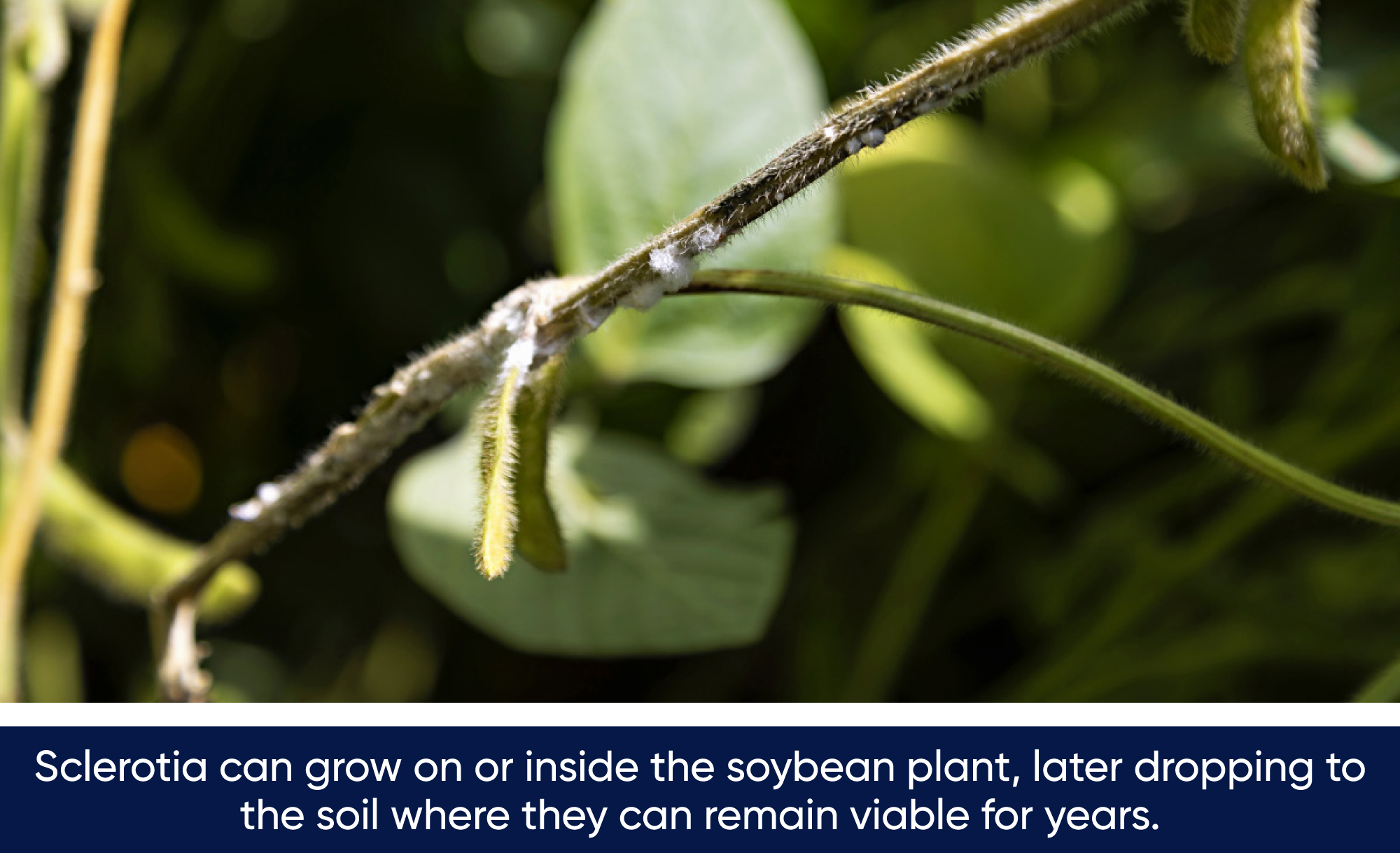
Sclerotia can survive for several years in the soil. Once they reach a position near the surface, they germinate into gray-to-tan mushroom-shaped structures called apothecia, which release spores that spread by wind, infecting dead soybean flowers and spreading to the stems.
White mold can persist in numerous hosts aside from soybeans including crops like alfalfa, clover and edible beans, and weeds such as lambsquarters, pigweed and ragweed. In addition, it thrives in areas of early planting, narrow row width and high plant populations — situations common to high-yield farming.
Scouting: At Canopy Closure
In the North Central region, late June through early July is usually the best time to scout for apothecia. Farmers should examine areas where moisture can collect:
- Under closed canopies
- Under plants in high soil moisture areas
- Areas subject to fogs, long dew periods or poor drainage
Note that harmless mushrooms, like the birds-nest fungus, mimic the appearance of apothecia, but grow from organic residue rather than from sclerotia.
Scouting: During Pod Set
When scouting for white mold during pod set, farmers should inspect areas lacking wind disturbance, like tree lines or portions of the field with thick canopies. Signs to watch out for include:
- Patches of fields with scattered, dead plants.
- Wilted plants. To avoid mistaking drought signs for white mold, check for water-soaked lesions that reach above and below the affected nodes.
- White, cottony growth and sclerotia growing on plants.
Management
White mold tends to flourish in regions with wet, cool weather, but can appear anywhere or any time these conditions are present. Additional factors that add to the risk of white mold infestation include:
- Favorable weather with temperatures ranging from 70°F–85°F, especially under overall wet conditions
- Rapid canopy development producing early row shading
- Narrow row width
- Plant populations of 175,000 plants per acre or greater
- Fields with a history of white mold
- Planting varieties with low white mold resistance
- Short crop rotation periods or rotating to susceptible crops such as sunflowers or canola
- Poor management of weeds that play host to white mold
- Poor drainage areas
- Tree lines or other barriers to air movement
Resistant Varieties
The use of high-quality seed with resistance to white mold can help reduce the incidence of infestation. Soybean varieties receive a rating of 1 to 9 according to their genetic tolerance to white mold. You can help customers determine which varieties best fit their situation.
Cultural Control Methods
- Crop rotation – Rotation to a non-host crop can reduce the buildup of sclerotia in the soil, but because they can remain viable in soil for up to ten years, it may take more than a one-year rotation to have an effect. Non-host crops suitable for rotation include corn, sorghum and small grains.
- Tillage – The reported effects of tillage are mixed. While deep tillage may initially reduce white mold by burying sclerotia deep in the soil, sclerotia buried 8–10 inches deep may be moved back to the surface during later tillage.
- Canopy management – Conditions that speed canopy closure increase the potential for white mold. Row spacing greater than 20 inches may reduce white mold, but this does not always result in an acceptable tradeoff in yield. When modifying planting practices, consider whether the resulting compromises are acceptable.
- Weed control – White mold finds hosts in a wide range of broadleaf weeds, including common vetch, wild mustard and henbit. Controlling these weeds not only removes hosts, but may assist in providing a less dense canopy, discouraging white mold growth and improving yield by reducing competition for resources.
- Irrigation management – Since white mold favors cold, wet environments, farmers should avoid excessive and frequent watering, especially prior to and during flowering. Frequent, light irrigation is less likely to create a suitable environment for white mold.
Chemical Control Methods
Foliar fungicide treatments used in conjunction with cultural practices can be beneficial in controlling white mold in fields under high-risk conditions. Aproach® fungicide provides broad-spectrum control of foliar and soil-borne plant diseases. Its unique properties allow it to quickly move into and within the plant, protecting poorly covered leaf surfaces, plus stems and leaves that have not yet emerged. Aproach also delivers protection closer to the soil surface for control where plant diseases like white mold originate.
Viatude™ fungicide is another option for white mold control, with the same proven disease control and performance of the active ingredient in Aproach (Onmira™ active) plus prothioconazole for added white mold protection. Four movement properties in Viatude allow it to quickly surround, penetrate and protect leaves and stems, providing complete plant coverage with rapid absorption and translocation.
Both Aproach and Viatude can be used in a two-pass system and combined with other management practices to help prevent disease resistance.
Foliar Fungicide Application Tips
- Foliar fungicides have a decreased effect on established white mold, so apply them prior to infection.
- Around R1, soybean blooms are especially vulnerable to white mold infection, making this an optimum time for fungicide application. Canopies are still open, making for more effective spray coverage.
- Soybeans are susceptible to white mold infection throughout flowering, which can last 30 days or longer. A second application may be necessary if conditions favoring infection continue into midsummer.
- Later fungicide applications can contribute to reduced canopy penetration, especially in narrow-row situations, reducing their effectiveness.
White mold can be a serious problem, but that doesn't mean your customers are helpless against it. By knowing the signs and practicing diligent scouting, farmers can catch the disease before it becomes established. Combining sound cultural control methods with proven crop protection tools like Aproach and Viatude fungicides can help farmers defend against this potentially damaging fungus, ensuring healthy plants and protecting yield, season over season. Follow this link for more information.
™ ® Trademarks of Corteva Agriscience and its affiliated companies.
Aproach® and Viatude™ are not registered for sale or use in all states. Onmira™ is a registered active ingredient. Not all products are registered for sale or use in all states. Contact your state pesticide regulatory agency to determine if a product is registered for sale or use in your state. Always read and follow label directions. © 2026 Corteva. 037787 LC (07/26)
