
Country Selector
Please enter a valid location
Species specifics: Dalmatian toadflax

Fast facts
- Dalmatian toadflax is also commonly known as broadleaf toadflax, wild snapdragon or flaxweed.
- Highly aggressive and invasive weed that can significantly reduce favorable grass and forage populations, sometimes entirely outcompeting other species to form a toadflax monoculture if left unchecked.
- Found throughout much of the United States, spring flowers at the top of a spiny woody base resemble yellow snapdragons.
What to look for
Dalmatian toadflax (Linaria dalmatica), also known as broadleaf toadflax, wild snapdragon or flaxweed, is a highly aggressive invasive weed found across many U.S. states and can significantly reduce favorable forage production, sometimes entirely wiping out other species.
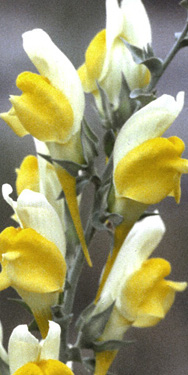
Provided by Smithsonian Institution,
Dept. of Botany, United States, WY,
Yellowstone national Park,
Mammoth Hot Springs
This herbaceous perennial typically grows 3 to 4 feet tall at maturity. A hairless, woody-based plant, the stems and leaves are waxy blue-green in color with heart-shaped leaves. Leaves are 1 to 3 inches long and clasp the stem where they attach.
Flowers emerge in May on the upper leaves and bracts and are bright yellow with a white to-orange bearded throat, somewhat resembling a snapdragon. Toadflax is extremely prolific, with each plant able to produce more than 500,000 seeds that are easily spread by animals, vehicles and wind.
Seeds do not go through periods of dormancy and can remain viable in soil for up to 10 years. In some conditions, new seedlings can emerge in fall, but often new seedlings emerge in Spring of the following year.
An elaborate root system below the soil surface – sometimes reaching depths and widths over ten feet – also aids in establishing new plants. If left unchecked, Dalmatian toadflax can dominate infested sites and completely outcompete other forages, leading to a monoculture population.
Where it is found
Dalmatian toadflax is a non-native species in the United States that has been reported in all regions except the Southeast and Gulf states. Because of its high prolificacy and ability to take over infested rangelands and pastures, many states and counties classify this weed as noxious.
How to treat it
Apply 2 to 4 pints per acre of Tordon® 22K* herbicide pat bud-to-flower growth stage or in fall when basal regrowth develops.
*Applications of Tordon® 22K over 2 pints per acre may result in damage of desirable grass species and forages.
Tordon® 22K is a Restricted Use Pesticide. Tordon 22K is not registered for sale or use in all states. Contact your state pesticide regulatory agency to determine if a product is registered for sale or use in your state. Always read and follow label directions.
Stay Connected With Us
Connect with Range & Pasture:


Connect with Range & Pasture: