
Country Selector
Please enter a valid location
Species specifics: Palmer amaranth

Fast facts
- An extraordinary seed producing, summer annual, in the pigweed family that typically produces more than 500,000 seeds per plant – up to double that under ideal conditions
- Over 30 U.S. states face Palmer amaranth populations that are resistant to certain types of herbicides
- Palmer amaranth is high in nitrates and can be toxic to cattle when consumed in high doses
What to look for
Palmer amaranth (Amaranthus palmeri) is a fast-growing warm-season annual in the pigweed family that is an extraordinary seed producer capable of developing populations that are herbicide resistant. A common foe for row crop farmers, Palmer amaranth can be a bane to cattle producers managing grazing or haying systems, too.
An easy identifier of Palmer amaranth is its’ poinsettia-like rosette leaf arrangement when viewed from above. A central stem grows with lateral toothed leaves alternating up the stalk. The stem will grow 2 to 3 inches a day during peak growing season until reaching 3 feet tall; however, in populations that are herbicide-resistant, plants can exceed 6 feet in height and double their seed production.
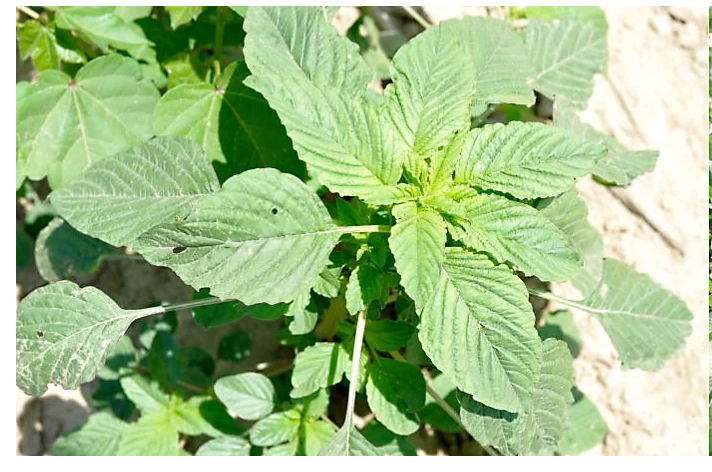
An easy identifier of young Palmer amaranth plants is by a poinsettia-like leaf arrangement when viewed from above.
Female plants can be identified by green, spiny, thorn-like bracts, which are normally located at the base of the petiole and measure up to one-fourth inch in length. Comparatively, males are distinguished by their long, drooping flowering structures. White or whitish-green flowers on male and female plants usually cluster in cylindrical spikes that can reach up to up to 3 feet in length off the plant’s central stem. As a dioecious plant that has male and female flowers growing on different plants, Palmer amaranth can rapidly diversify its genetics and develop traits to help populations thrive, including herbicide resistance after repeated treatments of the same chemical.
The plant produces fruit from the flowers which separates at the top – typically in late summer through the first killing frost – exposing 500,000 or more black to dark purple one-half-inch diameter seeds. Germination from seeds typically occurs in warmer seasons when temperatures near the soil surface reach at least 60°F — generally in May or June — however, some parts of the country have seen germination occur as cold as 41°F.
The seeds spread in many ways and, with their hard coating, can remain viable through a variety of environments. Common sources of spread via farm activities include farm equipment and vehicles, contaminated seed and contaminated livestock feed such as cottonseed meal or hay, with up to 30% of the seeds surviving ruminant digestion.
Palmer amaranth is high in nitrates and can be toxic to cattle when consumed in high doses; however, cattle will generally avoid the plant for other favorable forages when available.
Where it is found
Native to southwestern regions of the United States, Palmer amaranth has migrated throughout much of the contiguous United States and most recently has begun to establish populations into northern non-native climates, including Minnesota, Montana, South Dakota and Wisconsin. Save for some isolated cases, Palmer amaranth has not yet established in the Pacific Northwest or the upper Northeast.
Due to its aggressive nature, resistance to some herbicides and toxicity to livestock, Palmer amaranth appears on numerous state and county noxious weed lists throughout the Midwest, with more than 30 states facing populations of herbicide-resistant Palmer amaranth.
How to treat it
Because Palmer amaranth seed can remain viable for up to five years, maintaining a robust population of native grasses and legumes, in addition to a rotation of chemical treatments, is an effective tactic in controlling infestations and slowing the establishment of new populations.
The best time to treat Palmer amaranth with an herbicide is in the early vegetative stages, typically occurring in May to early June. Treat with DuraCor® herbicide at 16 to 20 fluid ounces per acre with MSO at 1% volume/volume, GrazonPD3™ herbicide at 20 fluid ounces per acre or Chaparral™ herbicide at 2.25 fluid ounces per acre with MSO at 1% volume/volume.
GrazonPD3™ is a Restricted Use Pesticide. GrazonPD3 is not registered for sale or use in all states. Contact your state pesticide regulatory agency to determine if a product is registered for sale or use in your state. GrazonPD3 is not for sale, distribution or use in Nassau and Suffolk Counties in New York State. Under normal field conditions DuraCor® is non-volatile. DuraCor has no grazing or haying restrictions for any class of livestock, including lactating dairy cows, horses (including lactating mares) and meat animals prior to slaughter. Label precautions apply to forage treated with DuraCor to manure and urine from animals that have consumed treated forage. DuraCor is not registered for sale or use in all states. Chaparral™ has no grazing or haying restrictions for any class of livestock, including lactating dairy cows, horses (including lactating mares) and meat animals prior to slaughter. Label precautions apply to forage treated with Chaparral and to manure and urine from animals that have consumed treated. Consult the label for full details. Chaparral is not registered for sale or use in all states. Contact your state pesticide regulatory agency to determine if a product is registered for sale or use in your state. Always read and follow label directions.
Stay Connected With Us
Connect with Range & Pasture:


Connect with Range & Pasture: