
Country Selector
Please enter a valid location
Stop feeding weeds; maximize spring forages with the right herbicides

Cattle producers are consistently looking for ways to stretch their dollars and improve production practices. Spring is an ideal time to evaluate return on investment when it comes to forage potential. The last thing producers want to do is waste good fertilizer on bad weeds.
By spring, Andrew McCrea of McCrea Family Farms identifies what his pastures need. To boost soil fertility, he works with his retailer to apply fertilizer and DuraCor® herbicide together with UltiGraz℠ Pasture Weed & Feed. Combining fertilizer with the herbicide saves producers time with one pass over the ground and gives them the advantage of both technologies. Lush grass with fewer weeds means more cattle per acre, less supplemental feed, and more desirable forage on grazing and haying acres.
In pastures with annual lespedeza, McCrea turns to NovaGraz™ herbicide to keep weeds at bay. NovaGraz enables producers to preserve white clover and annual lespedeza while providing enhanced broadleaf weed control, reaping the benefits of added legumes in pastures while improving forage quality. McCrea evaluates the forage plan on his operation northeast of St. Joseph, Missouri, following a productive grazing season.
“We saw such good results with NovaGraz last season and how it allowed the annual lespedeza to grow and thrive. We're going to sow some annual lespedeza in pastures where we don't have any currently, just because we think that the NovaGraz was good for us and it allows us to have more diversity in the pasture.”
—Andrew McCrea of McCrea Family Farms
Scott Flynn, Ph.D., global biology leader for Pasture and Land Management at Corteva Agriscience, outlines the benefits of adding multiple types of legumes for forage diversity in pastures. The added protein benefit for livestock is very appealing.
“White clover is really nice to introduce into these cool season grass pastures,” Flynn said. “It is tolerant to lower soil pHs and poor fertility, so it is a little more forgiving than many other legumes. Now, annual lespedeza is the same, but having white clover in there also is going to help you out with your nutritional needs for your cattle. It’s high in crude protein. It's a very leafy, soft-stem plant. And so having a little more diversity into a pasture is really a good thing.”
McCrea is keenly aware of the importance of soil testing to maximize potential forages in each pasture. He takes corrective action regarding soil fertility to make sure he’s getting the most out of the herbicide and fertilizer he’s applying every year.
“We've been soil testing about every four years or so, and then we've come back and we'll correct with lime and sometimes other fertilizers,” McCrea said.
When referring to frequency of soil testing, Flynn said, “I think the longer you're in a pasture, the more you start to realize how things may shift. And if we're on new land or a relatively new farm, probably sampling every couple of years makes sense until you figure out how things tend to shift over time with grazing. So, in some cases that three-to-four-year mark may be fine for the particular operation that you're in.”
He goes on to highlight the potential differences in soil requirements depending on the type of forage stand.
“With legumes, a lot of times when we send in a soil test and we specify the crop that's going in, and in this case, fescue and annual lespedeza, usually the extension service will come back and say, ‘This is what we would recommend as far as the application goes.’ It's not going to be nitrogen, most likely, but phosphorus, potassium, maybe some of the macro and micronutrients in there,” Flynn said. “So, as a friend of mine said, if you don't test, you're forced to guess. In a system where you’re growing legumes and grasses, they have slightly different needs in terms of fertility than a pure grass stand.”
Pasture management isn’t one-size-fits-all. McCrea evaluates his fields often and uses results from soil sampling to keep improving forage production.
“Over time, we've been able to manage the fertility of the pastures well,” McCrea said. Sometimes I feel like we've got so far to go, but we look back and say, ‘Well, we have accomplished a lot too.’”
Flynn encourages producers to build forage diversity in pastures. He emphasizes the importance of making your pastures more resilient and improving the quality of forages for livestock.
When it comes to spring pasture management, insight reigns. Don’t guess-test. Maximize the pounds of usable, nutritional forage in your fields and don’t feed the weeds.
Contact your local Corteva Range & Pasture specialist to learn more about industry-leading pasture management solutions.
Hear more about the McCrea’s pasture management program in this video:
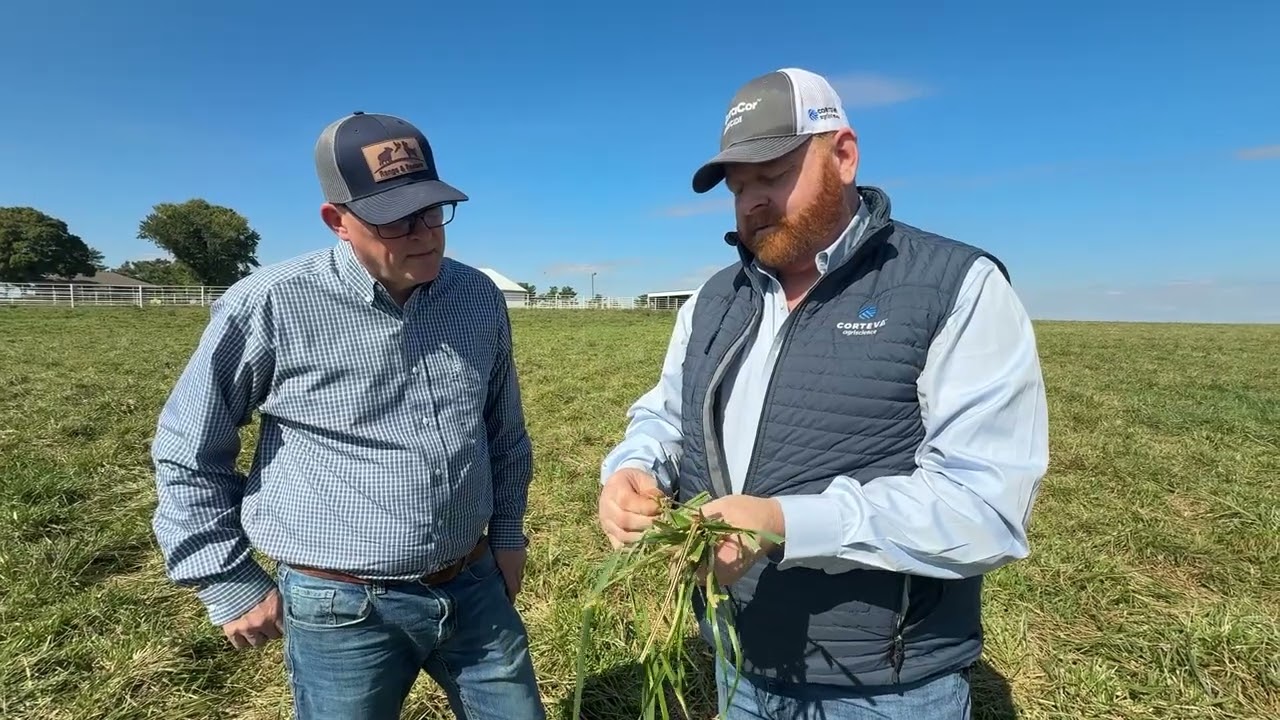
Soil Fertility and Pasture Weed Control
Find out what is on Andrew McCrea's to do list in the spring. McCrea raises cattle and prioritizes pasture management in northwest Missouri.
Soil Fertility and Pasture Weed Control
Find out what is on Andrew McCrea's to do list in the spring. McCrea raises cattle and prioritizes pasture management in northwest Missouri.
White clover and annual lespedeza exhibit some initial injury (such as lodging and loss of vigor) with NovaGraz™ but recover. Under normal field conditions, DuraCor® is nonvolatile. DuraCor has no grazing or haying restrictions for any class of livestock, including lactating dairy cows, horses (including lactating mares) and meat animals prior to slaughter. Label precautions apply to forage treated with DuraCor and to manure and urine from animals that have consumed treated forage. Consult the label for full details. DuraCor and NovaGraz are not registered for sale or use in all states. UltiGraz℠ with fertilizer is available for use with specific herbicides in the states of AL, AR, CO, FL, GA, HI, IA, ID, KS, KY, LA, MN, MO, MS, MT, NC, ND, NE, NV, OK, OR, SC, SD, TN, TX, UT, VA, WA, WI, WV and WY. Contact your state pesticide regulatory agency to determine if a product is registered for sale or use in your area. Always read and follow label directions.