
Country Selector
Please enter a valid location
Chart a better weed control program

Handy herbicide classification tables can help you better understand if your chemical strategy will be effective.
With so many crop protection products on the market, farmers may find it difficult to keep track. As more farmers implement multiple herbicide sites of action into their weed control program, focusing on herbicide group numbers and the basics of sites of action could help them minimize and manage resistant weeds better. But is it enough?
According to the 2022 Iowa Farm and Rural Life Poll, 78% of surveyed farmers reported that they use multiple herbicide sites of action in each application to manage herbicide-resistant weeds, up from 60% in 2013.
It’s proven to be a smart strategy to use multiple effective sites against target weeds in each field or specific areas. However, weed resistance can reduce a group number’s value; simply adding different sites of action doesn’t guarantee better control — you must ensure all weeds in each field are addressed.
For example: If your target weed in Field A is waterhemp that is resistant to glyphosate (Group 9) and ALS (Group 2), then a premix herbicide with only groups 2 and 9 will not manage this waterhemp population. Neither of these sites of action is effective in that instance. But if you pick a premix with groups 4 and 9, at least Group 4 should work. Preferably, adding in another product like glufosinate (Group 10) would provide two effective modes of actions working on the waterhemp.
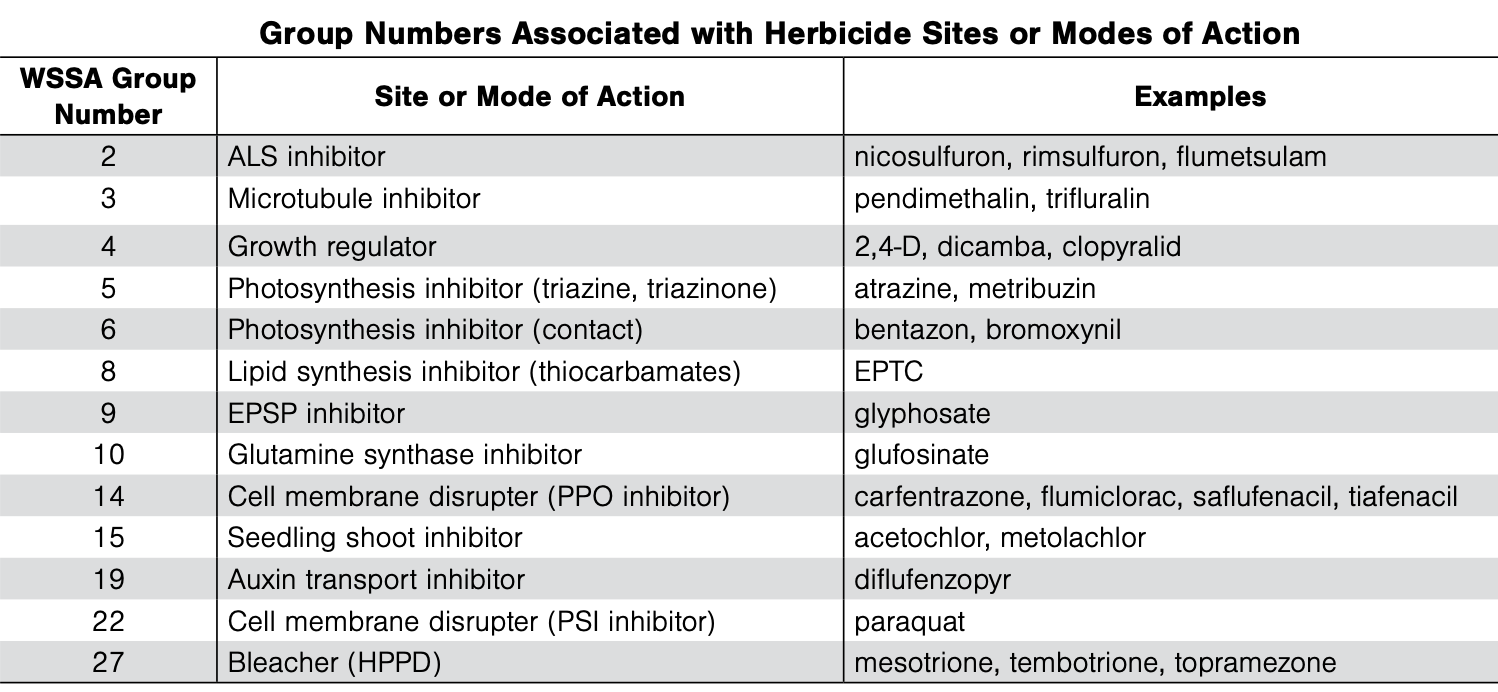
Turn to the chart
University weed scientists update the flagship Take Action Herbicide Classification Chart every year, led by Christy Sprague, Ph.D., Professor, Crops and Soils Sciences Program Director and Extension Specialist at Michigan State University. Use it to quickly and efficiently sort through your herbicide program. The overall goal is weed management, not herbicide management.
The chart is organized by mode of action (how products control weeds), then by color-coded site of action Group numbers (0-29). Site-of-action Groups identify where an herbicide active ingredient interrupts a biochemical process causing herbicidal activity. For example, Group 2 (ALS Inhibitors/sulfonylurea) and Group 9 (EPSP Synthase Inhibitor/glyphosate) inhibit different enzymes in the plant; but their modes of actions are similar, because they both are amino acid synthesis inhibitors.
“The chart is arranged in groups of how they work on the plant,” Sprague said. “For example, Group 4 (Synthetic Auxins/2,4-D, dicamba, clopyralid) are all growth regulator herbicides that show similar plant symptomology like leaf cupping or twisting. The number indicates where the active ingredients disrupt a plant function to cause death.”
Learning the group numbers can only help categorize application types to a point. Group 3 (trifluralin) and Group 15 (S-metolachlor, pyroxasulfone) both inhibit seedling root or shoot growth, making them useful as preemergence products. Whereas categorizing Group 2 herbicides doesn’t work, because products vary greatly in residual activity, application type and crop differences when applied to corn and soybeans.
“A good chart exercise, and one we teach in class, is to compare two weed control programs to determine how many different herbicide sites of action are used and if they are effective or not,” Sprague said. “We know most of our marestail in Michigan resists ALS and glyphosate, so has groups 2 and 9 resistance. We review other herbicide sites of action that aren’t resistant and then discuss how a deeper dive into local resources helps determine which active ingredients control marestail.”
Scouting still important
If you’d like help finding a different herbicide program starting point, a new weed scientist-developed web-based tool “Check My Herbicide Plan” is active on the GROW website. Co-developer Michael Flessner, weed scientist at Virginia Tech, said the goal is to meet farmers where they are by providing a winter planning tool for discussion with their consultant or ag retailer.
Sprague emphasizes that knowing herbicide group numbers/sites of action is only part of the solution. Successful herbicide use demands scouting and applying local resource knowledge.
“Scouting is the No. 1 step every year to understand the weeds and their herbicide resistance in every field,” Sprague said.
End-of-season notes on weed misses caused by specific herbicide sites of action in every field are just as important as reviewing hybrid results.
Local resources
If you’re puzzled by identifying multiple herbicide resistances, use state Extension specialists, weed scientists and local consultants/retailers. Tap into this year’s weed control guide compiled by your state weed scientists. For example, Michigan State University’s 2026 Weed Guide offers great advice on herbicide resistance (pages 13-15).
Finally, be sure to rotate your weed control programs using different herbicide sites of action. Don’t make more than two consecutive applications of the same site of action against the same weed unless other effective control practices are included in the management system, Sprague advises.
Deeper dive:
- Use this GROW Tool to Learn How Many Effective Herbicide Modes You Actually Use: https://growiwm.org/use-this-grow-tool-to-learn-how-many-effective-herbicide-modes-of-action-you-actually-use/
- Take ACTION Herbicide-Resistance Management: https://growiwm.org/Take-Action-Home/
- Herbicide Lookup Tool: https://growiwm.org/take-action-herbicide-search-tool/
- Breaking Down 4 Key Herbicide Groups: https://www.corteva.com/us/Resources/crop-protection/corn/breaking-down-herbicide-groups.html
Content provided by DTN/Progressive Farmer
The More You Grow
Find expert insights on agronomics, crop protection, farm operations and more.