
Country Selector
Please enter a valid location
Using Drones for Vegetation Management: 3 Trending Topics

All across the U.S., vegetation and land managers are discovering the benefits of using drones in their operations. From improved mapping to highly targeted treatments and accessing remote locations, drones have quickly proved their utility.
Drone use for applications is booming. In 2021, the Federal Aviation Administration (FAA) issued 40 waivers to make drone spray applications. By the end of 2025, there were at least 1,700.
As quickly as drone use is expanding, so are the capabilities of the technology. Whether you’ve already put drones to work for you or you’re just starting to consider how they fit into vegetation management, we’ve identified three areas that are shaping current trends in drone application.
Hardware trends
First, machines are getting bigger, with more tank capacity and ability to carry bigger payloads. Improved batteries mean machines are more dependable and can cover more ground each day. Auburn University Extension Professor Steve Li, PhD, says that applicators can spray nearly any type of pesticide, herbicide, fertilizer and more — as long as it has an aerial label and feasible use rate for drones.
The precision of the spray itself is also improving. Travis Bui, PhD, is a regulatory science human safety expert at Corteva Agriscience who works on drone-related issues. “Many drones today have rotary atomizer technology, which lets you change the droplet size on the fly,” Bui explains. “If the weather conditions are changing, we can adjust the droplet size to match the label guidance without changing nozzles.” Droplet size is determined by the controller and automatically adjusts with a drone’s speed to ensure even dispersal.
Software trends
Artificial intelligence (AI) is helping advance drone technologies for mapping and application precision. Mapping software in non-spray drones can help identify specific areas of weed pressure before you even get out onto a patch of land. This can help an applicator target where — and where not — to spray. This helps in avoiding endangered species, desirable trees and vegetation, waterways and other sensitive areas.
Another way software is improving treatments is by monitoring product and battery levels on the drone itself, telling it when to return to base. As he looks to the future of drone software and hardware, Li believes a whole new level of automation is coming. Picture a system where a drone that’s running low flies right on top of an autonomous vehicle that automatically recharges the battery and refills the tank.
Regulatory trends
The Environmental Protection Agency (EPA) currently allows the spraying of products via drone if aerial application is listed on the product label. Right now, there’s no drone-specific labeling. In order to get to that point, Bui says the EPA needs to further assess the implications to drone-specific applications.
Corteva and others in the spray drone industry are working to add to the body of data the EPA will need. In addition to his role at Corteva, Bui is also chair of the Unmanned Aerial Pesticide Application System Task Force (UAPASTF), an organization founded to generate information and data to support pesticide exposure and risk assessments for drone-based applications by regulatory agencies around the world.
Corteva is playing a role in assessing drone performance and developing recommendations. Bui says, “We want to make sure product labels fit the needs of the community that’s going to be using the products.”
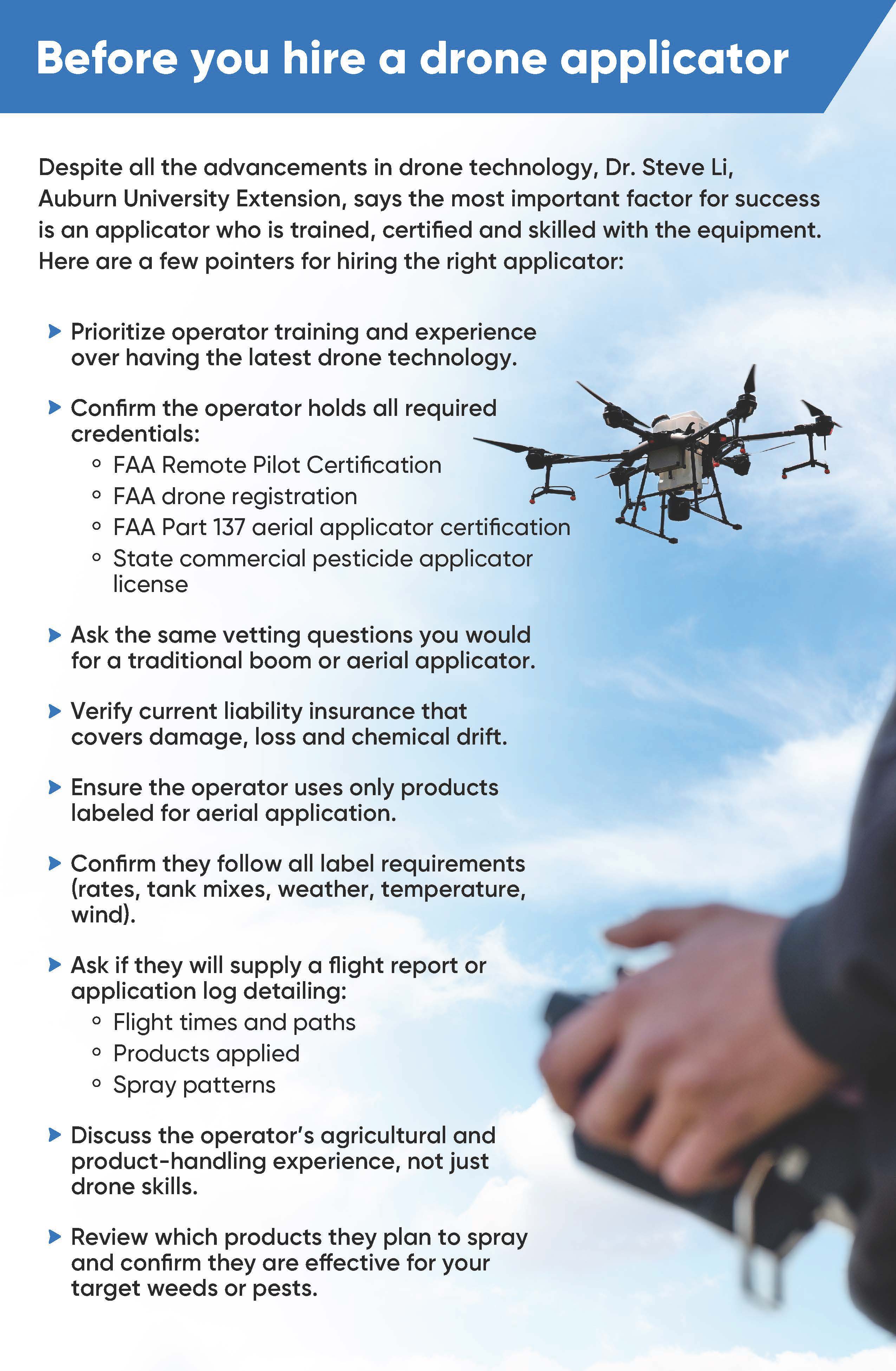
One thing the agricultural spray drone experts can agree on is this: The world of application drones will continue to grow and change — rapidly. But as good as the hardware and software are, Li emphasizes the human factor. “I think the key is the person running the drone,” he says, “because it’s mostly the people making the difference.”
And when it comes to the people that make up the community of drone operators, Li says it’s important for them to connect and network. To help in that, Li founded the Spray Drone End User Conference (SDEUC). SDEUC gives drone owners and operators and other application professionals a chance to ask questions, learn about new technologies and network with people working in the field. The 5th conference will be held in May 2027 in Savannah, Georgia. More information is available at SDEUC.com.
Vistas®
For over 30 years, Vistas® has covered strategies, trends and stories from across the Vegetation Management industry.