
Country Selector
Please enter a valid location
Managing Bareground With Sensitive Areas Nearby

Maintaining bareground calls for eliminating all the vegetation in an area, but that doesn’t mean ignoring surrounding sensitive areas. This article examines how to balance your vegetation management concerns — what species you need to control — with taking care to avoid damaging neighboring vegetation. We’ll highlight three common scenarios and questions to ask when planning your application approach.
Scenario 1: Near trees
Key question:
What tree species are nearby?
What do my product labels say?
Start by identifying the species of trees in the area and then check product labels regarding application near trees. Certain herbicides are labeled for treatment of vegetation under the tree canopy, as long as you avoid foliage contact. Milestone® herbicide can be used for weed control under the canopy of many common types of trees, including maple, oak, ash and poplar species. Vista® XRT herbicide is also an option which has fewer restrictions around trees. Your Corteva Agriscience vegetation management specialist can also help with recommendations when there are sensitive tree species nearby.
Scenario 2: Near crops
Key question:
What do my product labels say?
What are the drift concerns?
What are the volatility concerns?
In any vegetation management scenario, it’s good practice to limit herbicide movement toward crops. Unless the product you’re using specifically says it’s safe for a certain crop, assume what you’re applying will cause damage to crops. If you’re near rangeland or pasture areas, keep in mind that many herbicides used for bareground will also kill alfalfa, and some can kill desirable grasses.
Pay close attention to drift and volatility notes on labels. Drift and volatility are both causes of off-target movement, but they need to be managed as distinct issues.
Drift happens when spray droplets move through the air, usually due to wind. Drift is best managed by following label recommendations, including best practices around wind speed, direction at application and buffer zone requirements. Always use the nozzles, droplet size and pressure recommendations indicated on the label. Larger droplets are less prone to drift.
Volatility occurs when a spray solution turns into a vapor after application. Volatility is a characteristic of the herbicide formulation or active ingredient. Once the herbicide is in gaseous form, it can then move with the air and settle in a new place. If you’re treating areas near crops, it helps to choose products with low volatility. HighNoon® herbicide is one option that is essentially nonvolatile.
Scenario 3: Near Water
Key question:
Do I need to treat up to the water’s edge?
Do I need to treat in the water?
Areas like rocky borders on retention ponds might require bareground management right up to the water’s edge, calling for a herbicide that’s labeled for riparian areas. But if the treatment needs to overlap with the water or be in the water, look for aquatic use labeling. As an example, HighNoon® herbicide can be used up to the water’s edge, while the label for Freelexx® herbicide allows for application in riparian, wetland and aquatic sites.
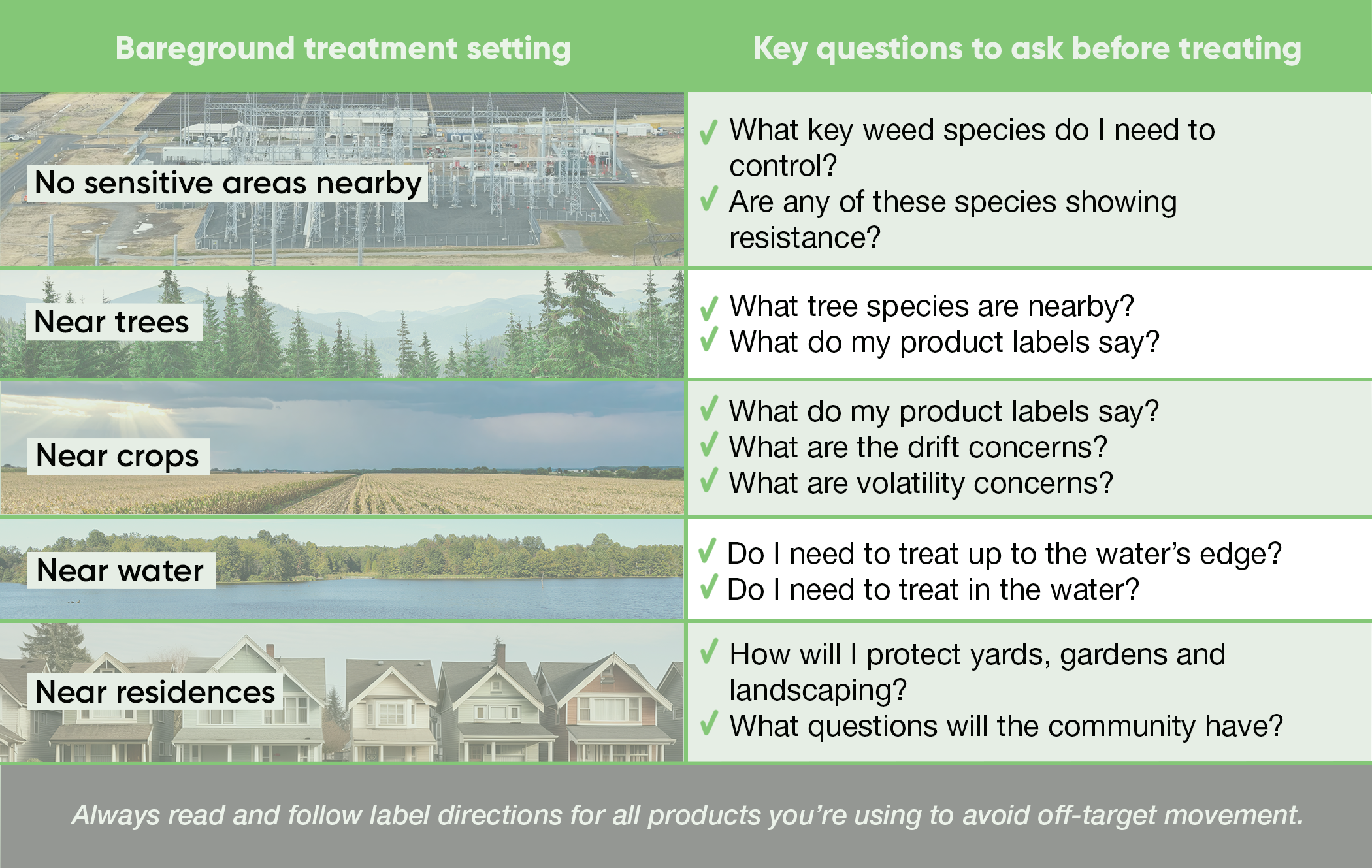
When no sensitive areas are nearby
For locations that do not border any sensitive areas, the task becomes at least a little less complicated. In this scenario, you can focus on the main weed species you need to tackle, including those that may be demonstrating resistance.
Kochia continues to be a major challenge in bareground maintenance. If this is true in your area, look for a product with resistant kochia control. Spike® 80DF herbicide provides proven kochia control and can be combined with HighNoon® herbicide for more modes of action and a wider spectrum of control that covers more than 140 weed species. Piper® EZ herbicide can also be included for a three-way combination that provides residual activity and defense against ALS-resistant weeds. It’s also good practice to add glyphosate to help control emerged weeds at the time of application.
While you’re focused on controlling weeds in bareground, don’t neglect the safety of nearby vegetation. Always review and follow all label recommendations to reduce the possibility of herbicide movement to help keep your bareground approach on-target for success.
Under normal field conditions, HighNoon® is nonvolatile. HighNoon and Milestone® have no grazing or haying restrictions for any class of livestock, including lactating dairy cows, horses (including lactating mares) and meat animals prior to slaughter. Label precautions apply to forage treated with HighNoon and Milestone and to manure and urine from animals that have consumed treated forage. When treating areas with Freelexx®, Milestone, Spike® 80DF or Vista® XRT in and around roadside or utility rights-of-way that are or will be grazed, hayed or planted to forage, important label precautions apply regarding harvesting hay from treated sites, using manure from animals grazing on treated areas or rotating the treated area to sensitive crops. See the product labels for details. State restrictions on the sale and use of Milestone, Spike 80DF and Vista XRT apply. Consult the labels for full details. Not all products are registered for sale or use in all states. Contact your state pesticide regulatory agency to determine if a product is registered for sale or use in your state. Spike® 80DF is a trademark of Nutrichem Company Limited. Always read and follow label directions.
Vistas®
For over 30 years, Vistas® has covered strategies, trends and stories from across the Vegetation Management industry.