
Country Selector
Please enter a valid location
Mitigating Wildfire Risk With IVM-Managed Fuel Breaks

Wildfires are growing in frequency and intensity. Increasingly, the threat of wildfire is reaching beyond its usual geographies. Maintaining fuel breaks through integrated vegetation management (IVM) can be one way to help limit the resulting damage.
Wildfires across the western U.S. and Canada have, unfortunately, become an all-too- regular occurrence. But it’s not uncommon today to hear about wildfires in places we don’t normally associate with them, like New Jersey, Maine, Wisconsin and Louisiana. With major wildfires no longer relegated to the West, vegetation managers across the country have an opportunity to help mitigate fire risks to protect infrastructure, landscapes and communities anywhere they work.
A growing wildfire threat
Changes in landscapes, wildland-urban interface and climate all play roles in fire risk. Woody cover in the eastern U.S. has increased by more than one-third over the last 30 years.1 In the South, forests have become denser and droughts more frequent.1 These densely wooded landscapes provide ample fuel for intense fires. A recent USDA Forest Service mapping project identified areas of significant fire risk in Florida, the Atlantic and Gulf coasts and southeastern Texas.2 Overall, the number of fires per year continues to increase — there were 10,000 more wildfires in 2025 than a decade before — and they are increasingly larger as well.3,4 By the end of this century, extreme fire events are expected to grow by 50%.5
The role of shaded fuel breaks
One fire mitigation strategy that is working for vegetation and land managers in the western U.S. is shaded fuel breaks. These areas of thinned vegetation are designed to reduce the speed, intensity and height of wildfires, helping firefighters get ahead of flames and reducing damage.
In the case of the 2024 Park Fire in northern California, a shaded fuel break maintained by Caltrans virtually stopped the fire in its tracks, sparing infrastructure, vegetation and residences from destruction. Organizations like Caltrans have learned that one of the keys to success with shaded fuel breaks is maintaining them using an IVM approach.
IVM combines vegetation control methods, such as mechanical removal, cultural and biological controls and the use of chemical herbicides. Researchers and organizations have found that using selective herbicides, such as HighNoon® herbicide, as part of an IVM approach to fuel breaks not only helps with keeping areas clear over long periods of time but can even encourage the growth of fire-resistant vegetation — species that hold water, grow closer to the ground or have widely spaced branches.
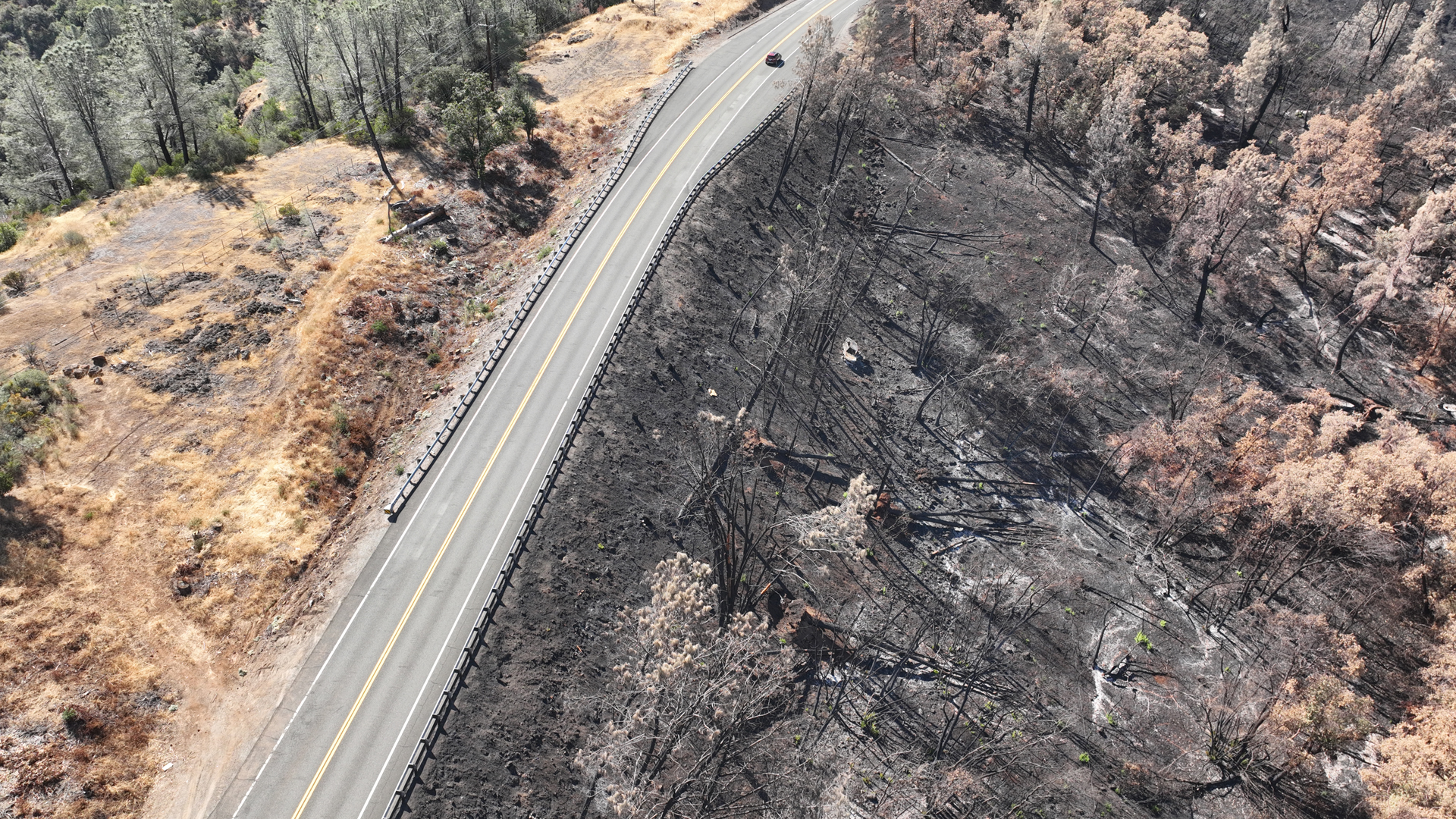
View of Highway 32 in Butte County, California, following the Park Fire in 2024. The fire stopped at the shaded fuel break on the left side of this image. (Photo courtesy of Caltrans.)
A model for vegetation management
Successful shaded fuel break projects out West provide a model that vegetation managers can follow across the U.S. They show that IVM approaches for roadsides and utility lines can benefit from multiple management approaches, including the use of managed fuel breaks. Using IVM in vegetation management zones — including incorporating shaded fuel breaks — can improve maintenance efficiency and help mitigate fire risks across the seasons, protecting the landscapes and communities we all care for.
1 M.A. Ivey et al., “Woody Cover Fuels Large Wildfire Risk in the Eastern U.S.,” Geophysical Research Letters 51 (2024), https://doi.org/10.1029/2024GL110586.
2 Kalen Breland, “A new ‘geography of fire’ defines southern wildfire risk,” USDA Forest Service, May 13, 2025, https://research.fs.usda.gov/srs/articles/new-geography-fire-defines-southern-wildfire-risk.
3 “Wildfires and Acres,” National Interagency Fire Center, accessed March 26, 2026, https://www.nifc.gov/fire-information/statistics/wildfires.
4 Virginia Iglesias, “LA fires: Why fast wildfires and those started by human activities are more destructive and harder to contain,” PreventionWeb, January 13, 2025, https://www.preventionweb.net/quick/92047.
5 “Are Wildfires Increasing or Decreasing in the U.S.?” Western Fire Chiefs Association, Edited September 17, 2024, https://wfca.com/wildfire-articles/are-wildfires-increasing-or-decreasing-in-the-us.
Under normal field conditions, HighNoon® is nonvolatile. HighNoon has no grazing or haying restrictions for any class of livestock, including lactating dairy cows, horses (including lactating mares) and meat animals prior to slaughter. When treating areas in and around roadside or utility rights-of-way that are or will be grazed, hayed or planted to forage, important label precautions apply regarding harvesting hay from treated sites, using manure from animals grazing on treated areas or rotating the treated area to sensitive crops. See the product label for details. HighNoon is not registered for sale or use in all states. Contact your state pesticide regulatory agency to determine if a product is registered for sale or use in your state. Always read and follow label directions.
Vistas®
For over 30 years, Vistas® has covered strategies, trends and stories from across the Vegetation Management industry.