
Country Selector
Please enter a valid location
Herbicide volatility in pasture management

When it comes to pasture weed and brush control, what happens after the spray leaves the nozzle matters just as much as the application itself. Most producers are familiar with physical drift, but herbicide volatility – the movement of the chemical that can occur after the spray has settled – is another factor that can have an adverse effect on nearby vegetation.
Drift versus volatility
In pasture and rangeland, off-target movement doesn’t just affect weeds or brush; it can also impact nearby crops, or sensitive plants, shelterbelt trees, landscaping or neighboring pastures. Both drift and volatility involve movement of herbicides to other vegetation, but they happen in different ways.
- Drift occurs during application when spray droplets move with wind.
- Volatility is the result of movement after application when the herbicide converts to a gas and moves away from the application site, similar to off-gassing.
The volatility of a product is influenced by the formulation, of a specific herbicide including the unique active ingredient in some solutions. Off-target movement from volatility can occur minutes or hours after spraying under certain environmental conditions, like warm temperatures followed by temperature inversions where vapors are carried offsite —common conditions in spring or fall herbicide treatments. Often, volatility is less visible than drift but can still have adverse implications.
Testing volatility of pasture management herbicides
To better understand volatility in some leading pasture management herbicide solutions available in the market today, Benny Martinez, Corteva Market Development Specialist, conducted a humidome demonstration to compare how these products drift.
Certain plants, such as tomatoes, are more sensitive to Group 4 herbicide volatility than others, which is why Martinez chose to use young tomato plants to observe off-target vapor movement in a controlled environment.

Hear Martinez introduce the demonstration in this video captured during the 2026 NCBA CattleCon tradeshow in Nashville, Tennessee.
Hear Martinez introduce the demonstration in this video captured during the 2026 NCBA CattleCon tradeshow in Nashville, Tennessee.
Demonstration objective
Evaluate how Corteva Range & Pasture herbicide solutions compare to other commonly used pasture and rangeland herbicides under controlled, common conditions where volatility is more likely to occur.
How the demonstration was conducted
The following herbicides were included in the demonstration:
- DuraCor® – 20 fluid oz/acre
- Weedmaster® – 48 fluid oz/acre
- GrazonPD3™ – 20 fluid oz/acre*
- Grazon® P+D [EL5] – 32 fluid oz/acre*
*GrazonPD3 and Grazon P+D contain the same active ingredients which allowed for a direct comparison of volatility in different formulations.
The demonstration setup focused on isolating volatility from other factors and observing effects on sensitive vegetation:
- Bermudagrass sod squares were treated at labeled rates using a calibrated CO₂ backpack sprayer (10 GPA) with a spray nozzle at 4 miles per hour (TTI11002 at 20 psi).
- Treated surfaces were allowed to fully dry.
- Tomato plants were placed next to treated grass and enclosed in a humidome chamber for 24 hours immediately after application. Temperatures were raised to 101 degrees fahrenheit for four hours and then allowed to return to ambient conditions.
- Plants were removed from the humidome and tomato plants were held in greenhouse-like conditions with grow lights and tray heating pads for 14 to15 days following humidome housing. Visual injury observations were made during this time to assess herbicide volatility affects.
Findings
Under conditions designed to promote volatility, differences between products became clear: Sensitive vegetation responded differently to volatility depending on the herbicide used. Interestingly, products with similar active ingredients did not behave the same, suggesting that formulation plays a critical role in how much movement occurs after application.

See how the tomato plants reacted to the volatility of the different herbicides used in this demonstration.
See how the tomato plants reacted to the volatility of the different herbicides used in this demonstration.

See how the tomato plants reacted to the volatility of the different herbicides used in this demonstration.
See how the tomato plants reacted to the volatility of the different herbicides used in this demonstration.

See how the tomato plants reacted to the volatility of the different herbicides used in this demonstration.
See how the tomato plants reacted to the volatility of the different herbicides used in this demonstration.
Key takeaways
- Volatility isn’t something that can be seen during application, but it is something that can be planned for.
- Choose the right herbicide solutions for the location and environment in which they will be used.
- Formulation matters — products with similar active ingredients can behave differently.
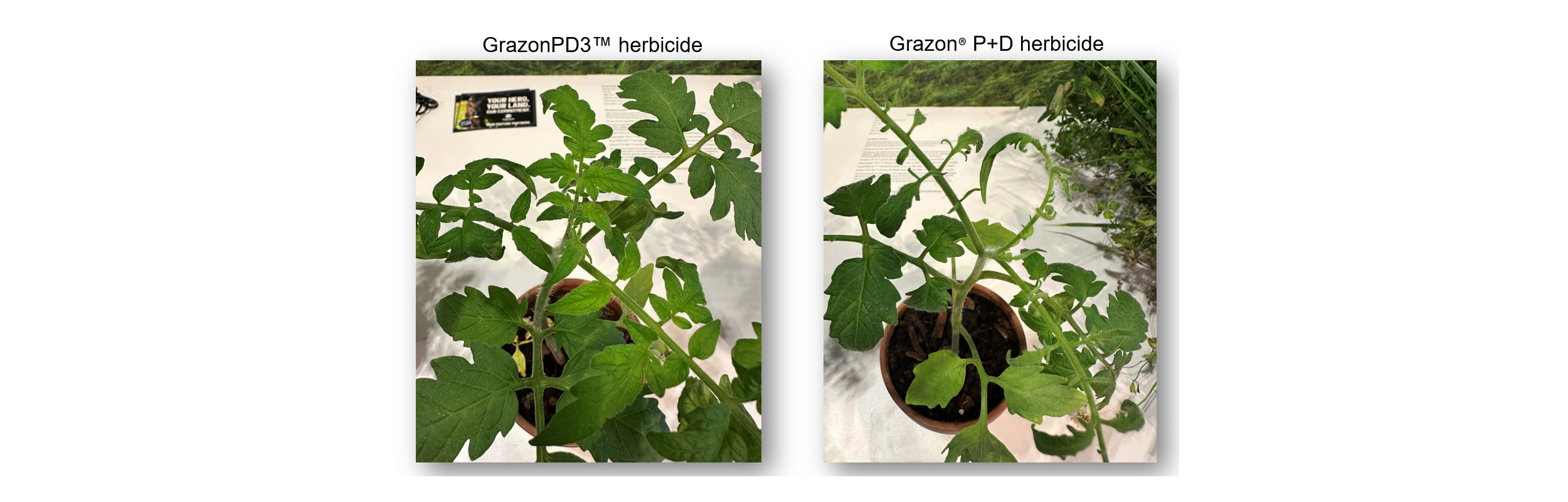
Tomato plants responded differently to two products with the same active ingredients – GrazonPD3 and Grazon P+D herbicides – suggesting formulation is a critical factor when determining which herbicide solution is right for the application environment.
- Monitor weather and apply during lower-risk conditions,[MB9] such as moderate to cool temperatures with consistent fluctuations, or periods of air movement after warming periods within 24 hours of application.
- Practice good land stewardship by protecting surrounding vegetation from off-target injury and always be sure to calibrate your equipment.

See the results and hear Martinez’ summarize what this demostratio shows.
See the results and hear Martinez’ summarize what this demostratio shows.
Stay Connected With Us
Connect with Range & Pasture:


Connect with Range & Pasture:
GrazonPD3™ and Grazon® P+D are Restricted Use Pesticides.
Grazon P+D is not registered for sales or use in all states. Grazon P+D is not for sale, distribution or use in Nassau and Suffolk Counties in New York State. Contact your state pesticide regulatory agency to determine if a product is registered for sales or use in your state. Under normal field conditions DuraCor® is non-volatile. DuraCor has no grazing or haying restrictions for any class of livestock, including lactating dairy cows, horses (including lactating mares) and meat animals prior to slaughter. Label precautions apply to forage treated with DuraCor to manure and urine from animals that have consumed treated forage. DuraCor is not registered for sale or use in all states. Contact your state pesticide regulatory agency to determine if a product is registered for sale or use in your state. Always read and follow label directions. GrazonPD3 is not registered for sale or use in all states. Contact your state pesticide regulatory agency to determine if a product is registered for sale or use in your state. GrazonPD3 is not for sale, distribution or use in Nassau and Suffolk Counties in New York State. Always read and follow label directions. Weedmaster® is a trademark of Nufarm.